Projects
Epilogue
Orpheus
NonFinito
Spectacular Failure
Hopes Return
Sunflowers
The Great Hoax
Houses in Tel Aviv
Rafi and Micha
The Happy Prince
Organza
Survival Episode
Lullaby for Colors
When Spring Falls Asleep
Flowers for The Holiday
The Bride and the Butterfly Hunter
Apple Flavor
2092
Take Out Your Phones
Information
[Uri Weinstein]
B. 1992, lives and works in Tel Aviv
alefweinstein@gmail.com
+97254-2300577
[Education]
2021-2023
MFA, Bezalel Academy of Art and Design, Tel Aviv
2020-2021
Alma-Matanel Fellows Program Alma House of Hebrew Culture, Tel Aviv
2020
Professional Development Program Edmond de Rothschild Center, Tel Aviv
2018
Student exchange, Fine Arts Department École des Beaux-Arts, Paris
2015-2019
BFA, Bezalel Academy, Jerusalem
[Solo & duo exhibitions]
2025
“Orpheus”, Nachum Gutman Museum of Art, Tel Aviv
2024
“Sunflowers”, Duo exhibition with Karen Dolev, Parterre Project Space, Tel Aviv
2023
“The Happy Prince”, MFA final exhibition, Bezalel Academy of Art and Design, Tel Aviv
2022
“Survival Episode” Art Cube Artists' Studios, Jerusalem
“When Spring Falls Asleep” Uri & Rami Nehoshtan Museum, Ashdot Ya'akov
[Group exhibitions]
2025
“NonFinito“, Artport, Tel Aviv
“Spectacular Failure“, CCA, Tel Aviv
2024
“The World Is Big“, The Lobby Art Space, Tel Aviv
“Evil Root”, Jerusalem Artists' House, Jerusalem
2023
“Labor and Idleness”, Beit Ha'ir Museum, Tel Aviv
“Spring Water”, Edmond de Rothschild Center, Tel Aviv
“Fresh Paint 2023”, annual art fair, Tel Aviv
“Gentleman’s Gift Shop” Studio Aliya 31, Tel Aviv
2022
“Lights Out”, Fine Art Department Gallery, Bezalel Academy of Art and Design, Jerusalem
“Organza”, collaboration with Karen Dolev, As part of the “Loving Art, Making Art” festival, Tel Aviv
“Meshalya”, Hansen House, Jerusalem
“Dictionary of Departure”, Shalma road 48, Tel Aviv
2021
“The Bride and the Butterfly Hunter”, “Loving Art, Making Art” festival, The Botanical Gardens, Tel Aviv
“The Age of Aquarius”, Halal Bastudio, Tel Aviv
“Apple Flavor”, Binyamin Gallery, Tel Aviv
2020
“2092”, Alfred Institute for Art & Culture, Tel Aviv
2019
“Take Out Your Phones”, BFA final exhibition, , Jerusalem
“Long Table”, listening performance, Factory #5, Haifa Museum of Art, Haifa
“Self-ish”, Photography Department, Bezalel Academy of Art and Design, Jerusalem
“My life goes where... #5”, HaMiffal gallery, Jerusalem
2018
“Grounds Mutual Grounds”, Fine Arts Department, École des Beaux-Arts, Paris
2017
“Rock Paper Scissors”, HaMiffal gallery, Jerusalem
“Ingredients”, The New Gallery Artists' Studios Teddy, Jerusalem
[Awards and Scholarships]
2025
Artport residency programme, Tel Aviv
2024
Young Artist Award, The Israeli Ministry of Culture
The Yehoshua Rabinovich Foundation for the Arts
2023
Michael & Pauline Lockman Scholarship, Tel Aviv
2022
Graduate degree prize for academic excellence, Bezalel Academy
2020
Visual Arts Grant, Yehoshua Rabinovich Foundation, Tel Aviv
2019
Artist Gyula Zilzer Prize, The American Friends of Bezalel
Creative Excellence Grant, America-Israel Cultural Foundation
Contact
e-mail ︎︎︎ alefweinstein@gmail.com
Epilogue
Overtones: Sound and Art (2026)
The Israel Museum, Jerusalem
Curator: Talia Amar
Musical production and performance: Avshalom Hasfari

“Epiogue” (2026)
Sound installation: speakers, white shirts, metal stands, 4:34 mins
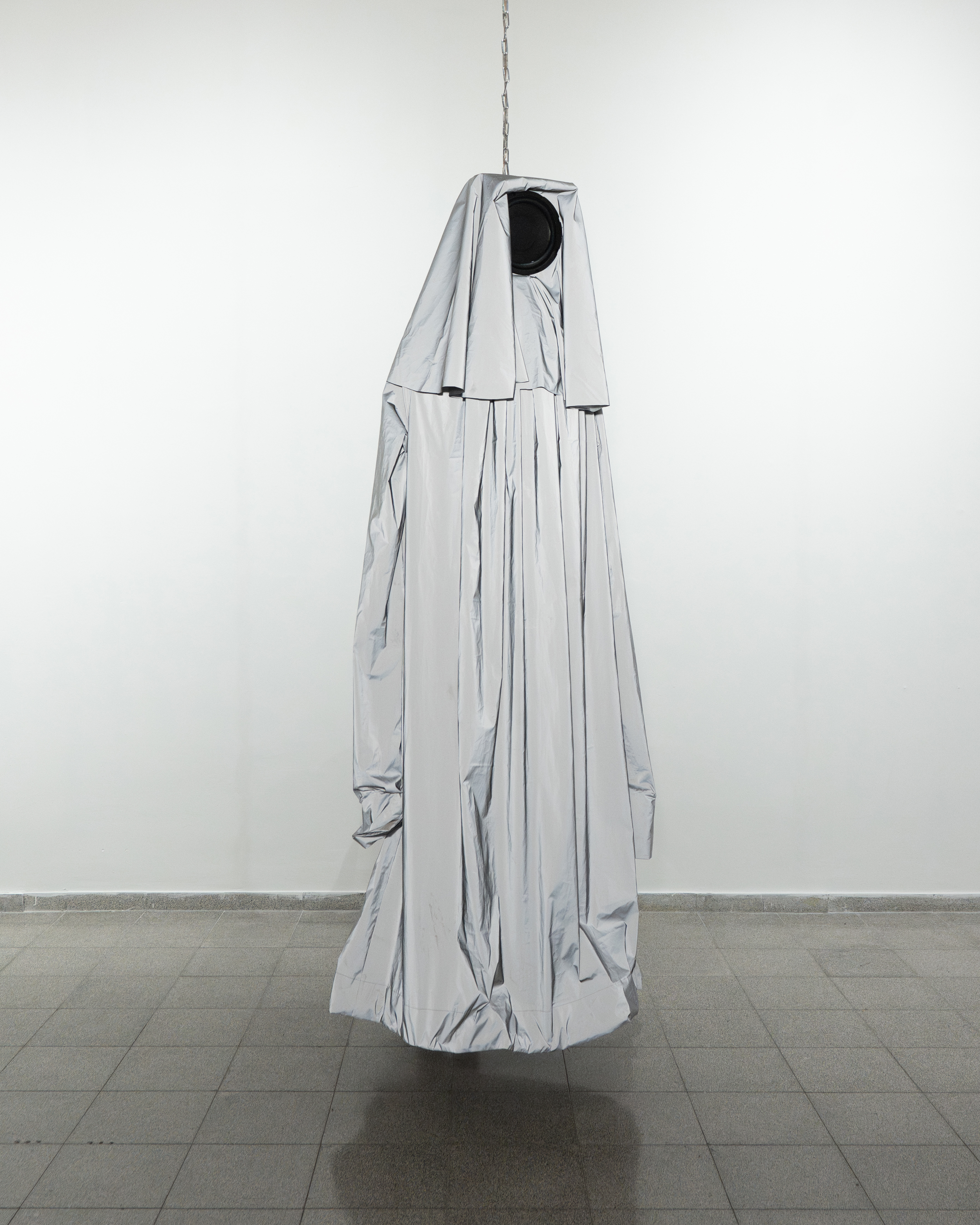
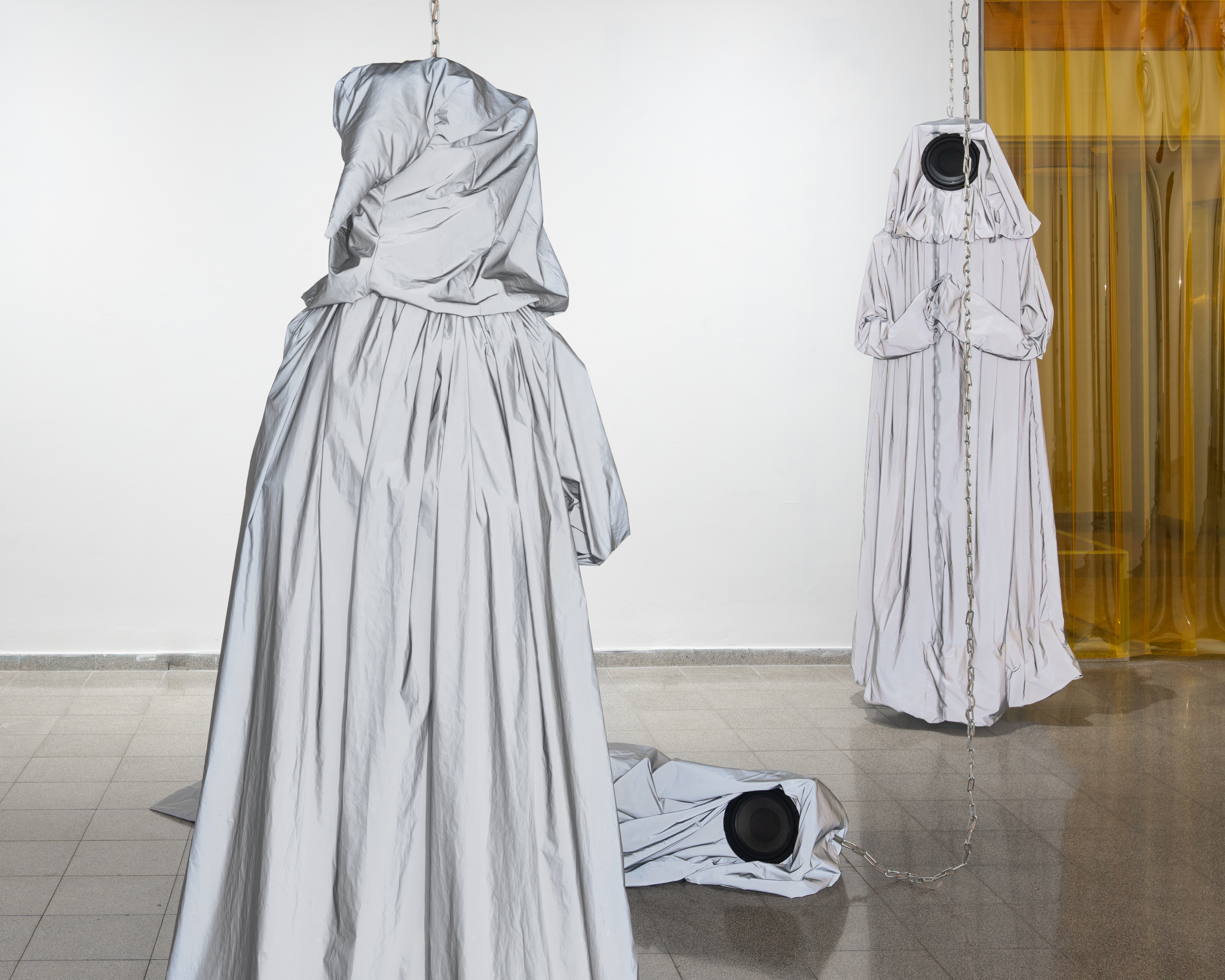
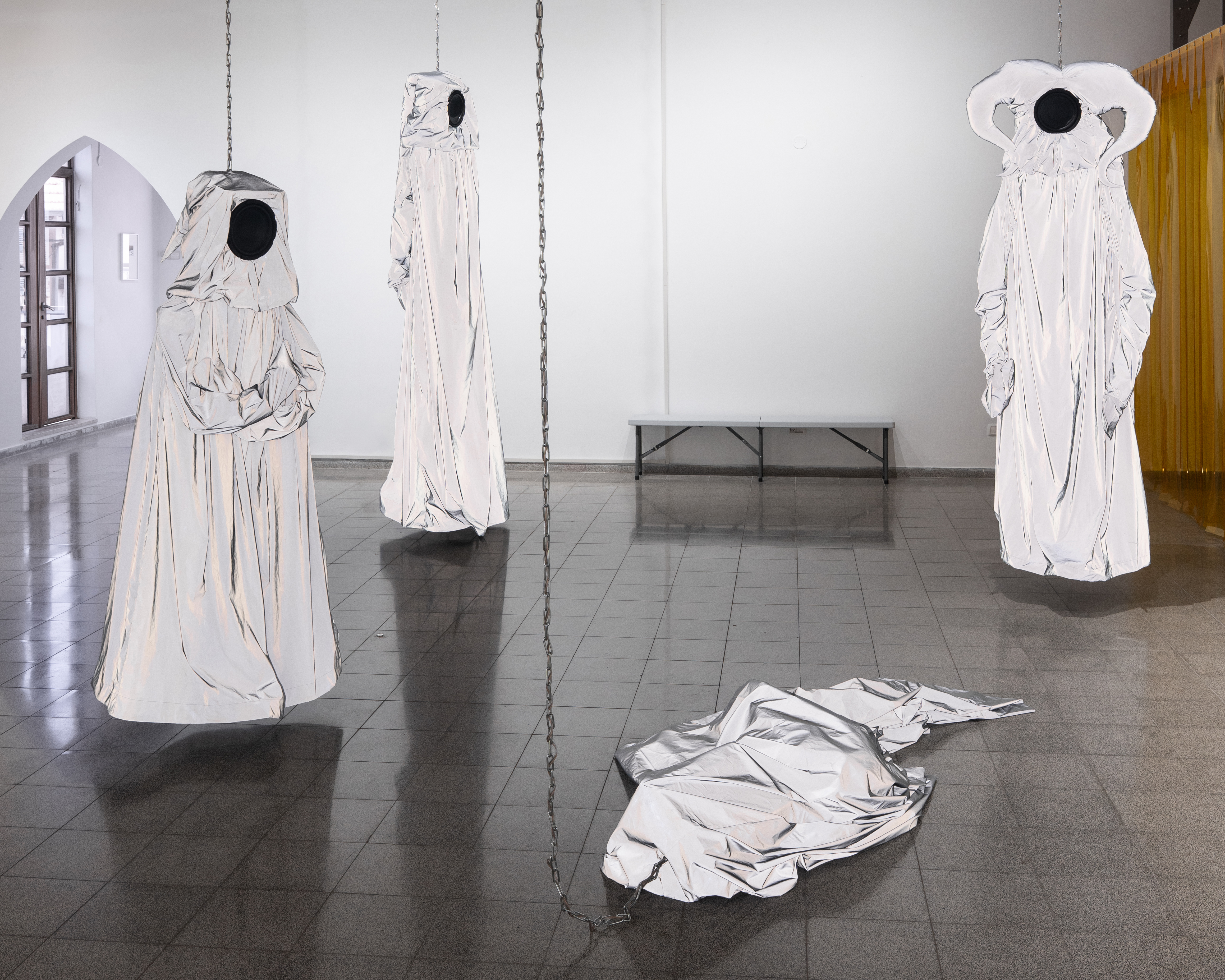
“Epilogue” is a sound installation composed of five speakers dressed in white button-up shirts, connected to one another and placed on stands, creating the appearance of an organized human-like group. Holding hands, the speakers perform “A Song for Peace” (“Shir LaShalom”), written by Yaakov Rotblit and composed by Yair Rosenblum.
The performance of the song is reduced to a repetition of a single line “Let the sun rise” rather than the full composition. This repetition creates a loop, a sense of an opening that never develops into a complete progression or resolution.
“A Song for Peace” was written as a call for peace, reconciliation, and an end to violence. In Israel, the song became a powerful cultural and political symbol of hope, while also carrying the weight of a painful contradiction between the aspiration for peace and the violent reality in which it is repeatedly invoked.
In “Epilogue,” the decision to remain only with the opening line emphasizes both the promise of hope and its fragility — as if hope is suspended at its very beginning, unable to fully unfold. The speakers, as technological bodies dressed and connected to one another, create the image of a unified choir that nevertheless remains unable to move forward.
Installation views by Elie Posner
︎︎︎ Video documentation


Tailoring: Elena Barash
The work includes the musical piece Song for Peace;
composer: Yair Rozenblum,
lyrics: Yaakov “Yankele” Rotblit
Rights management for Yair Rozenblum – Tson Barzel Music Ltd.
Rights management for Yaakov Rotblit – Hadar Geller
composer: Yair Rozenblum,
lyrics: Yaakov “Yankele” Rotblit

Orpheus
Orpheus (2025)
Nachum Gutman Museum of Art, Tel Aviv
Curator: Monica Lavi
Original Music: Avshalom Hasfari
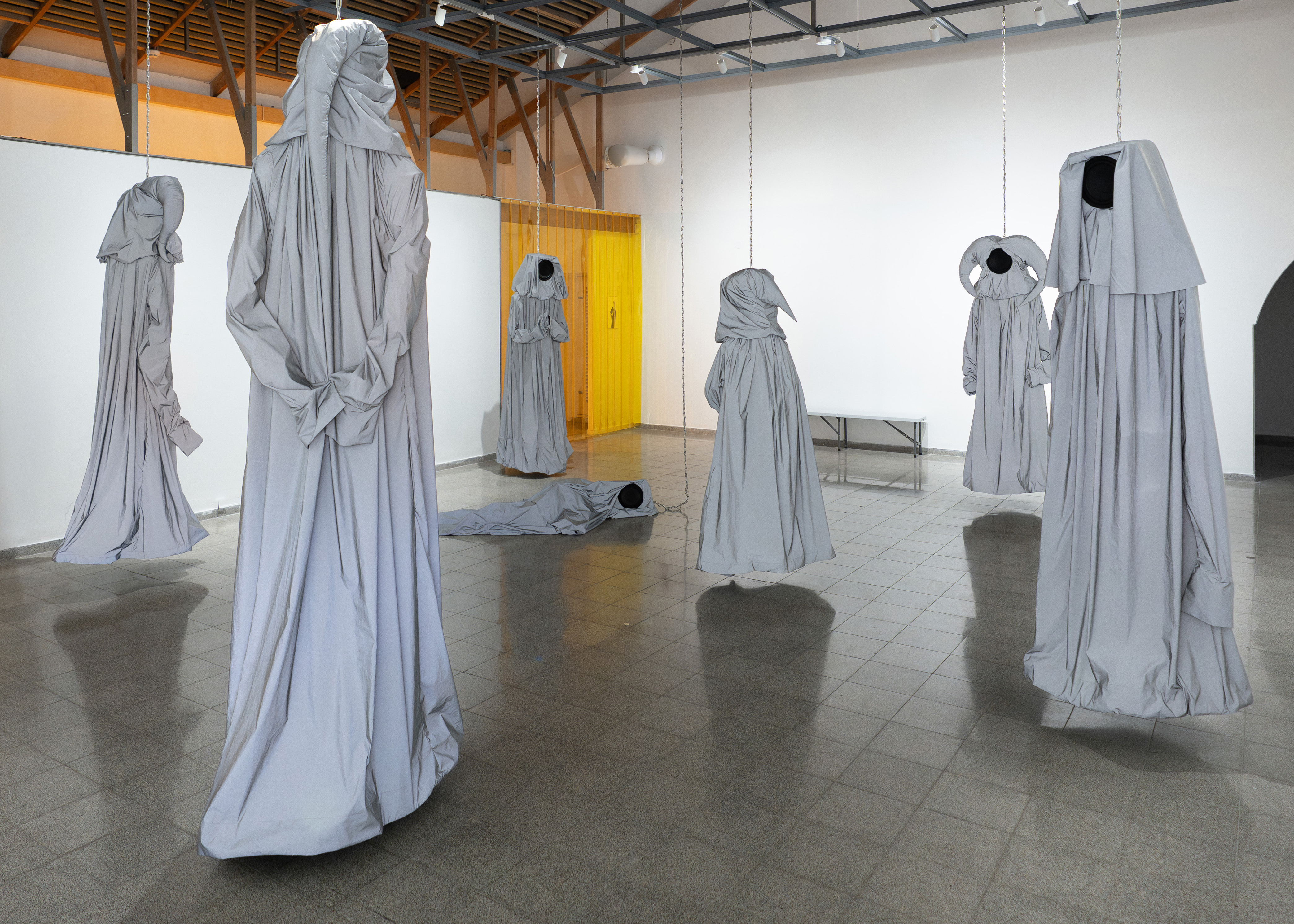
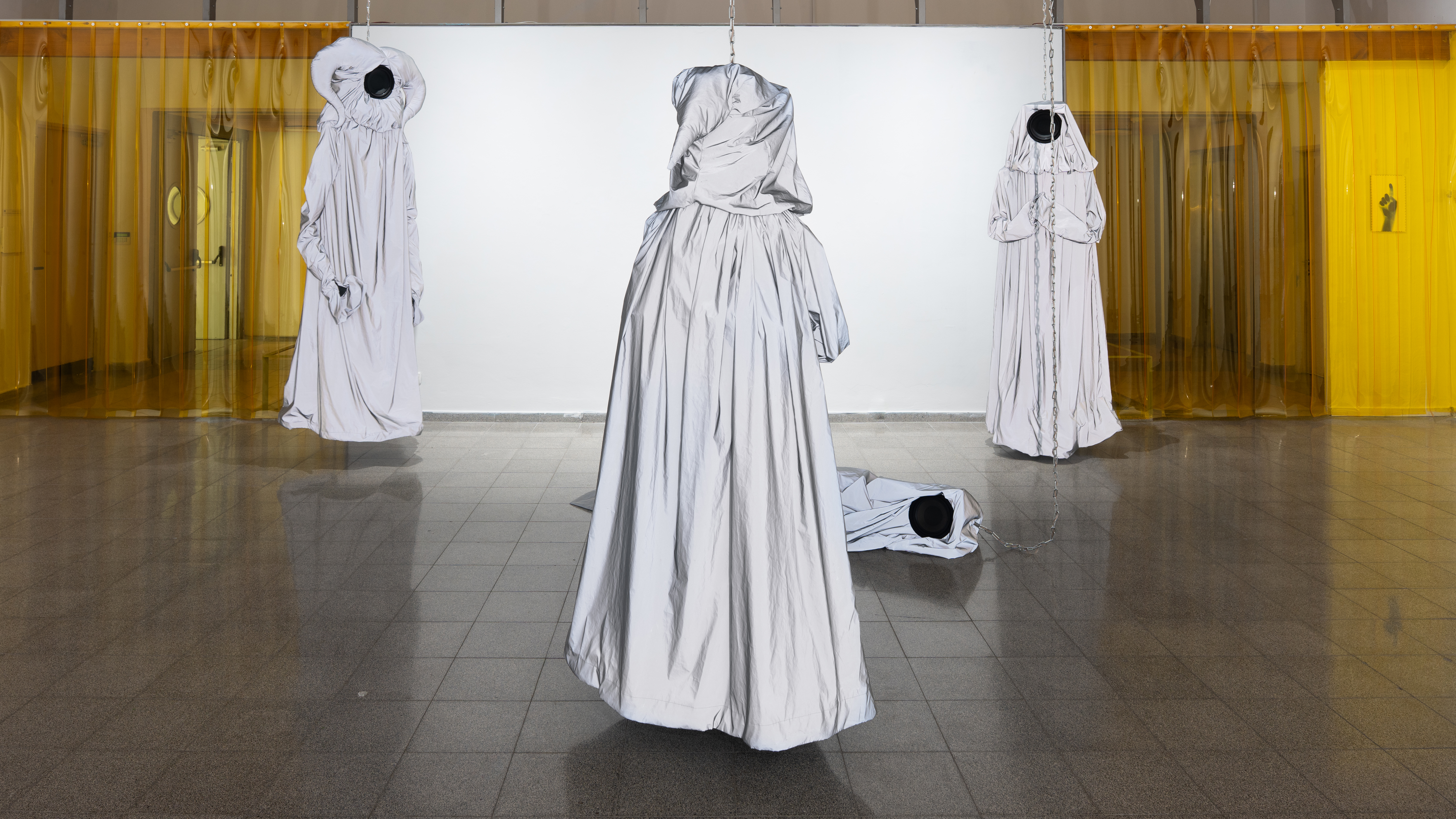
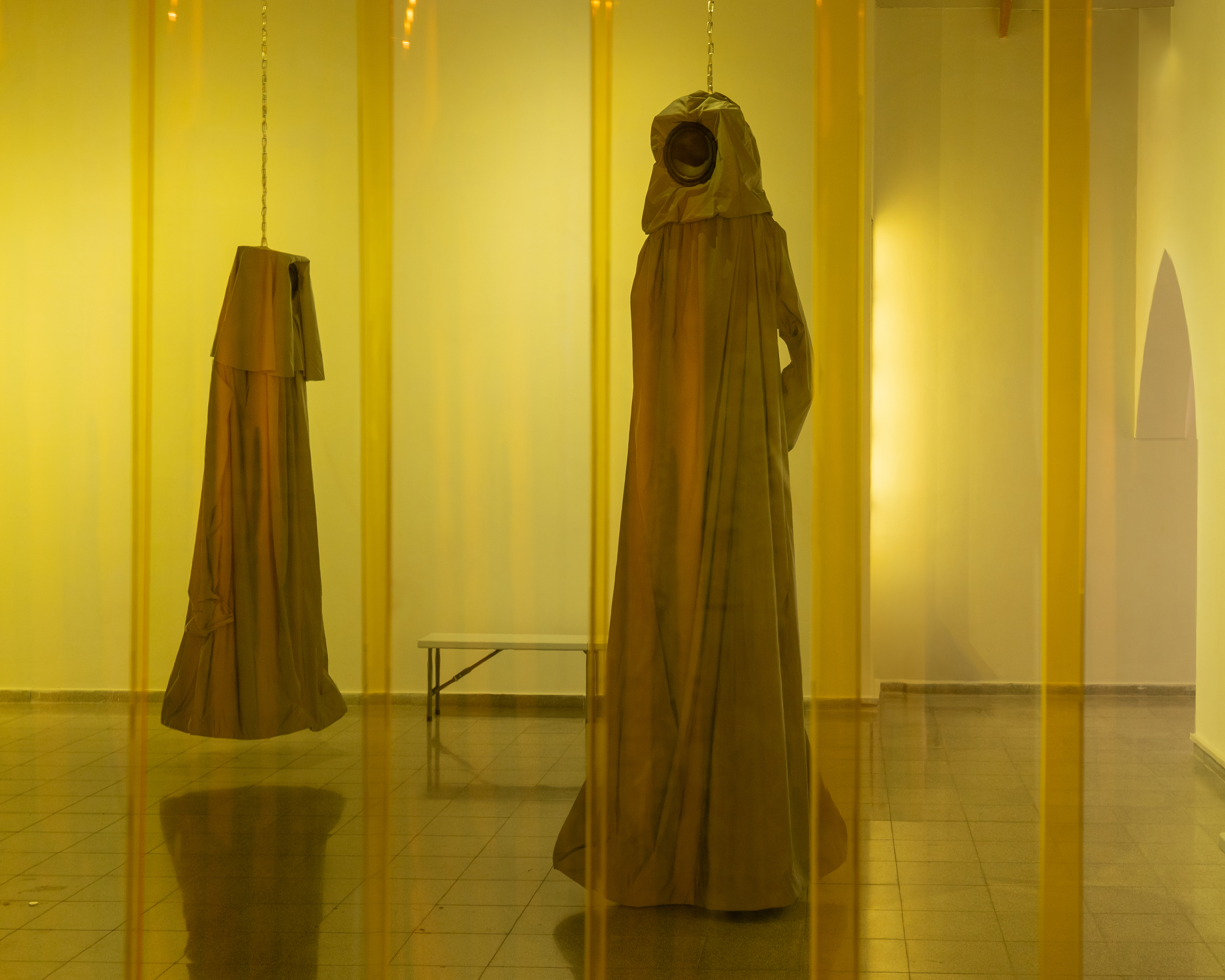
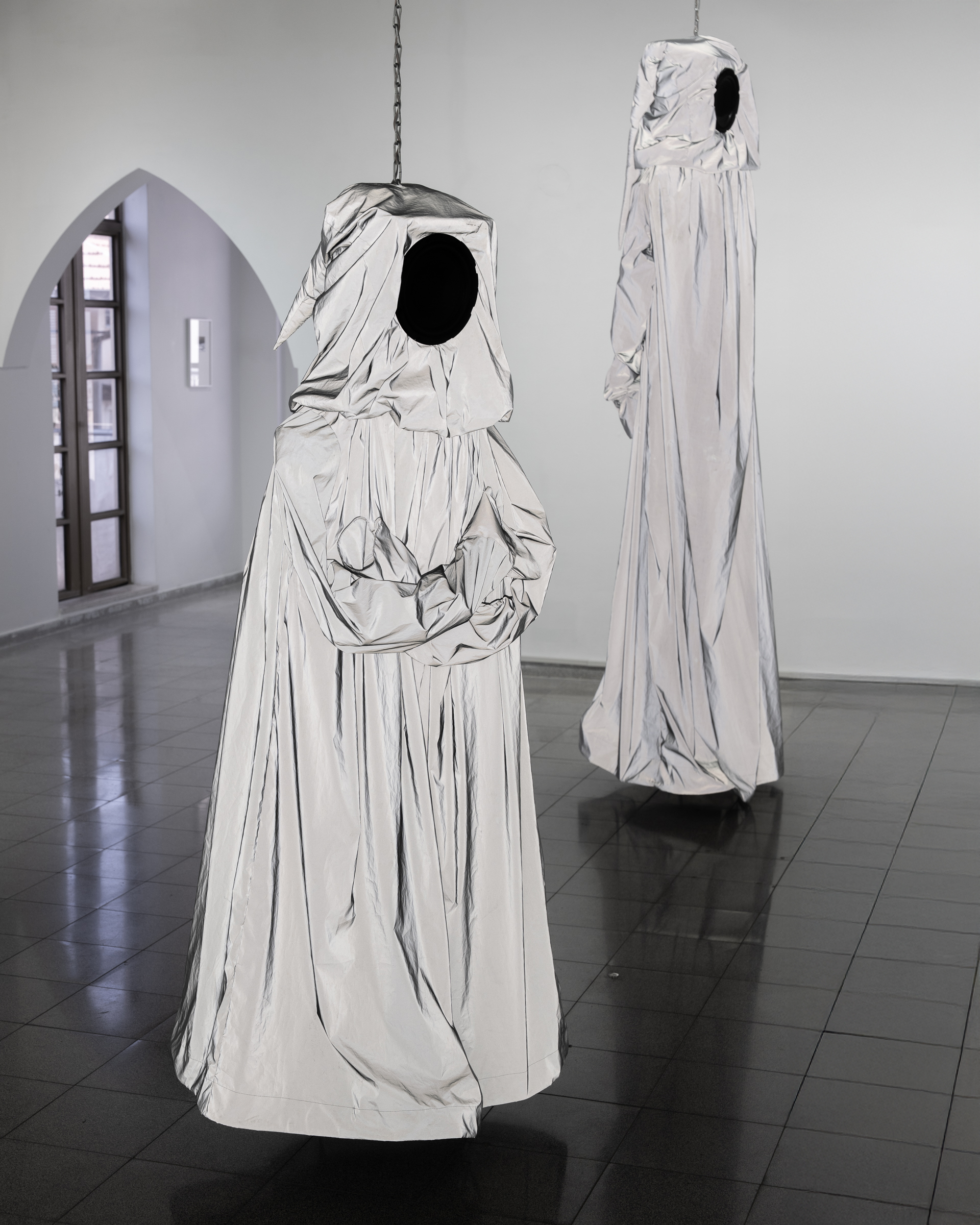
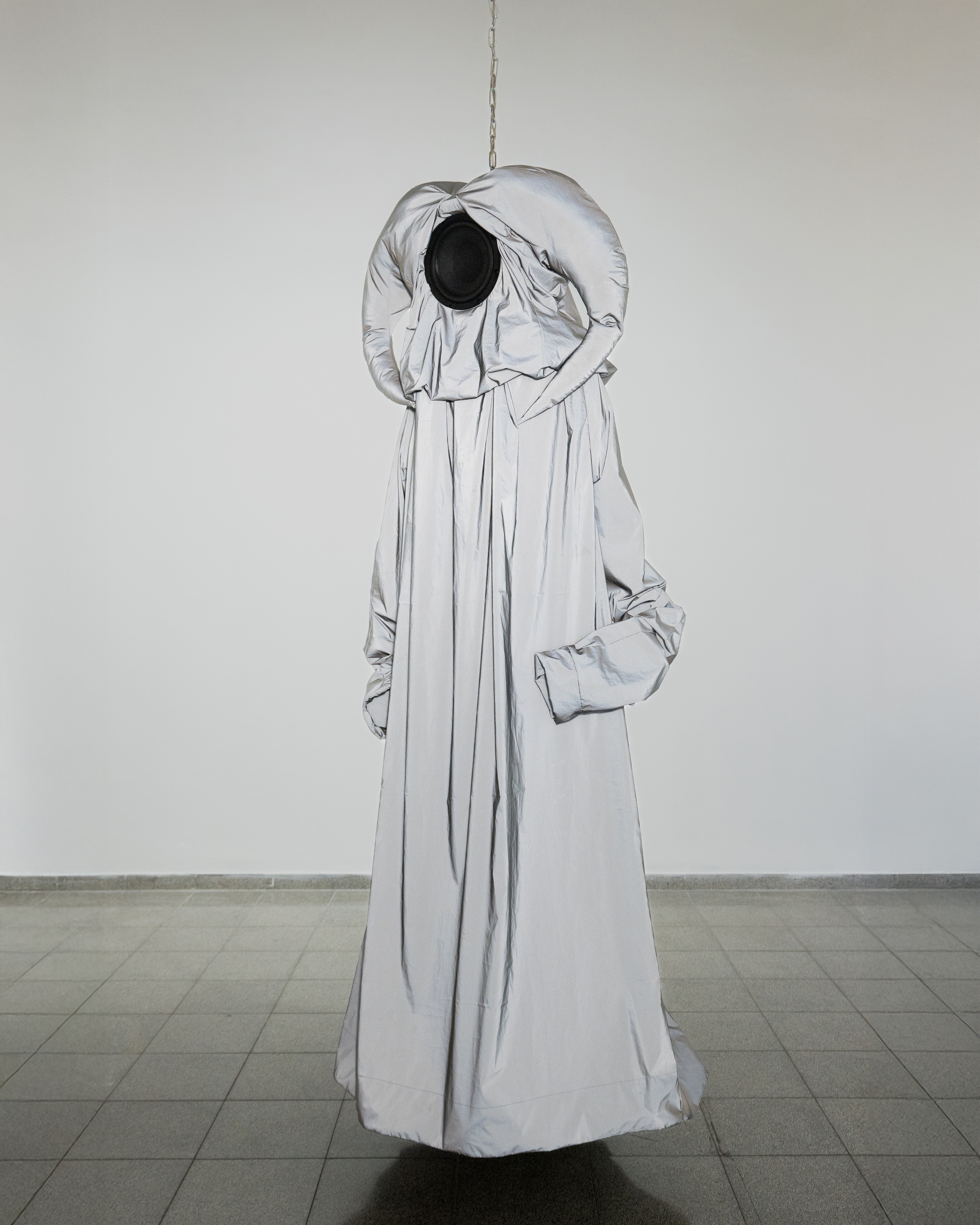
At the heart of the exhibition, the sculptural installation unfolds through five sound pieces, each composed from sampled and processed human voices. These sonic fragments trace the five stages of grief articulated by Elisabeth Kübler-Ross: denial, anger, bargaining, depression, and acceptance. Rather than forming a linear or narrative progression, the sounds emerge as states of affect: shards of denial surface as fractured, hesitant beats, resisting acknowledgment of death; they give wa
y to sharp bursts of anger; then to cyclical patterns of bargaining, echoing a plea that returns obsessively; followed by a slow descent into the weighted resonance of depression.
The final stage, acceptance, assumes a pivotal role. Here it is not rendered as dissolution or passive resignation, but as a charged moment of active recognition: the instant in which Orpheus, having traversed all stages of grief, turns to look back at Eurydice despite the fatal condition placed upon him. That glance becomes at once rupture and reconciliation an unflinching recognition that the beloved cannot return, coupled with a profound embrace of finitude. In this gesture, grief does not vanish but integrates into the very fabric of identity and memory.
In this way, sculptural sonic environment transcends the mere delineation of psychological stages. It offers a journey toward the threshold where death ceases to appear as an adversary to resist and instead becomes a presence one must learn to carry. Acceptance emerges not as an end but as a passage, akin to the myth itself: an opening into another dimension of existence memory.
Installation views by Tomer Fruchter
︎︎︎ Video documentation
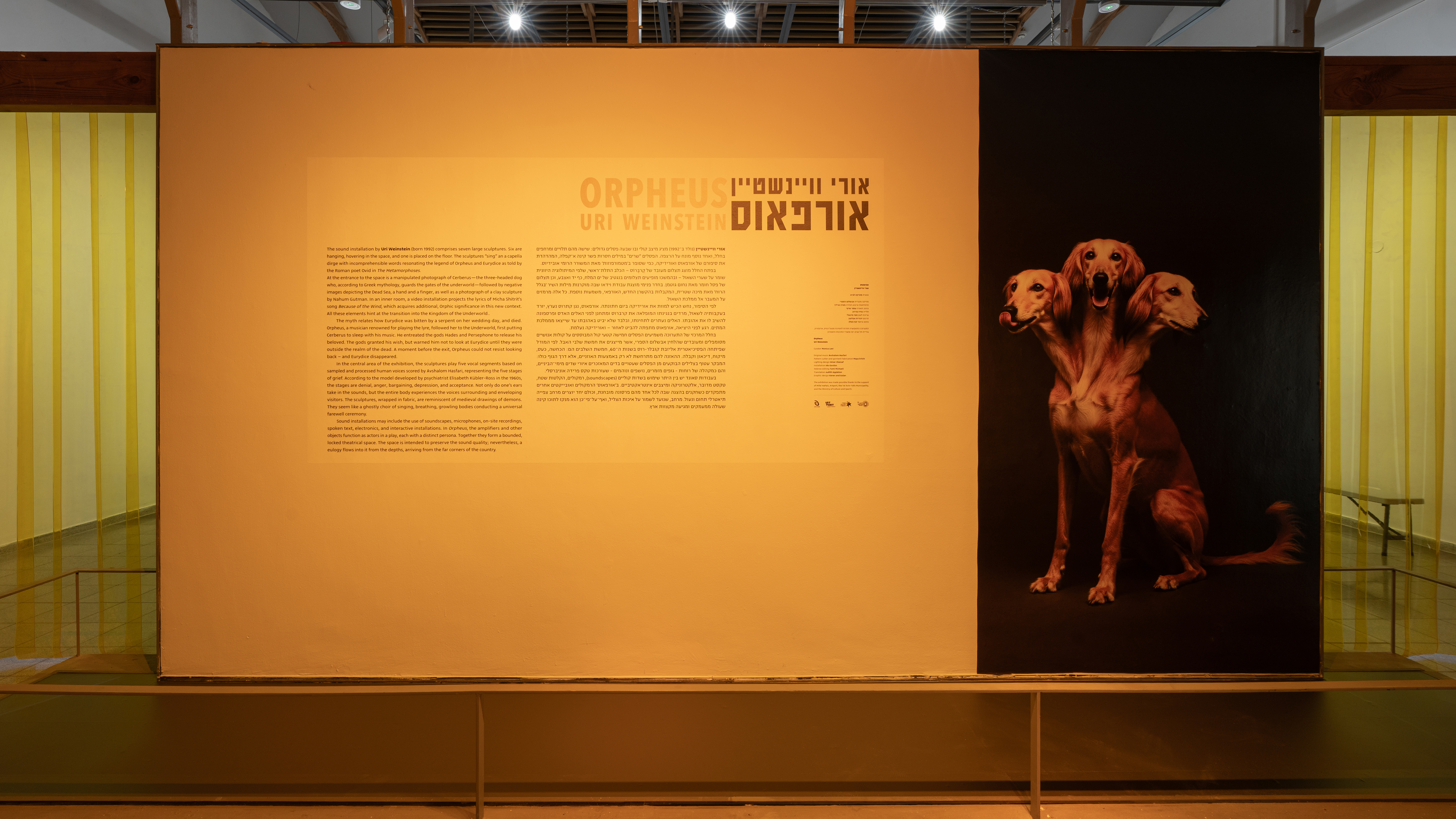

Yoslberus (2025)
wallpaper print, 290 x 150 cm
Cerberus, the three headed dog whose job was to prevent the living from entering and the dead from leaving. Orpheus played a tune so beautiful and sad that it managed to soften even the heart of the guard. The sounds of the music moved Cerberus so much that he let Orpheus pass without resistance.
 The condition (2025)
digital printing, 25x41 cm
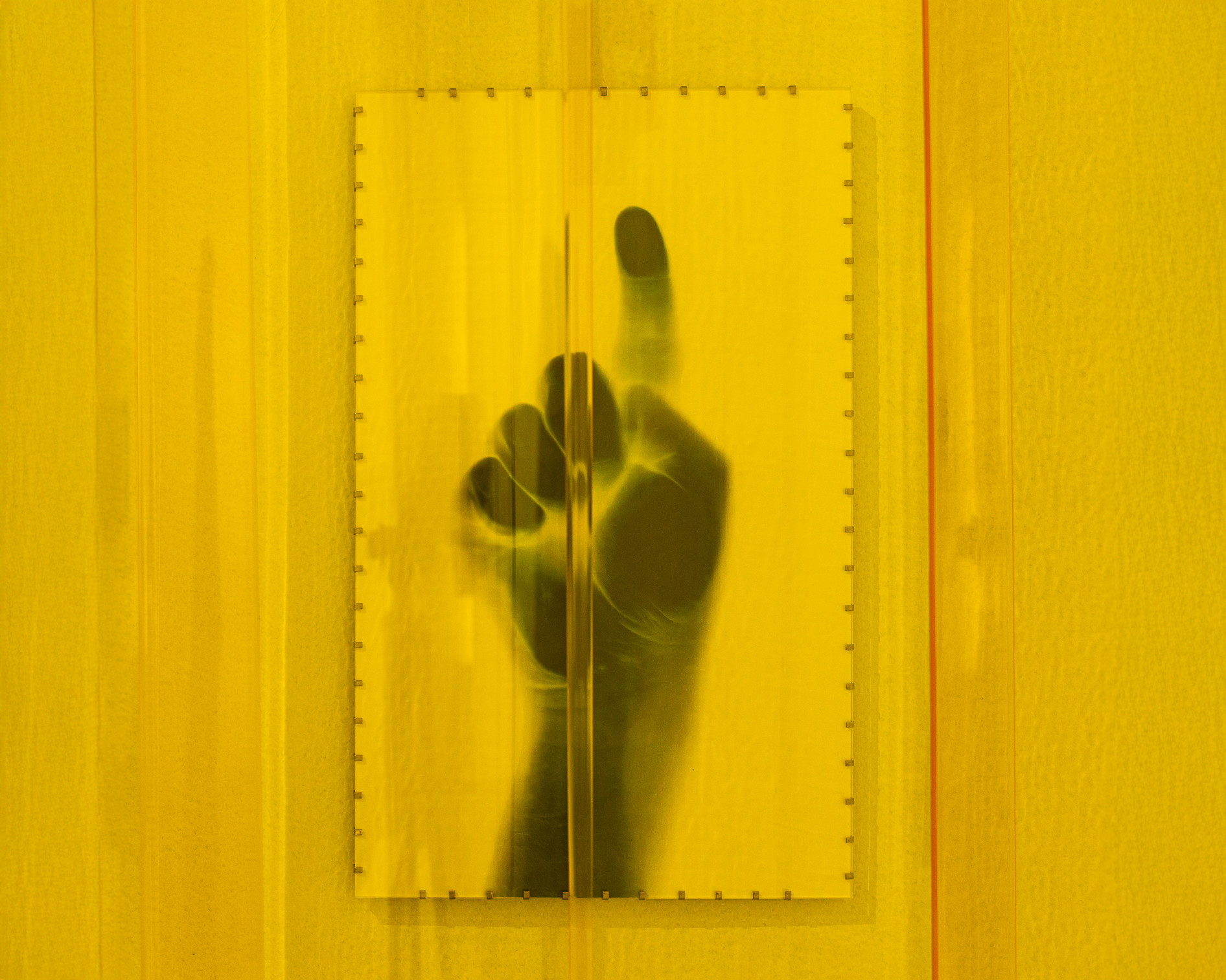
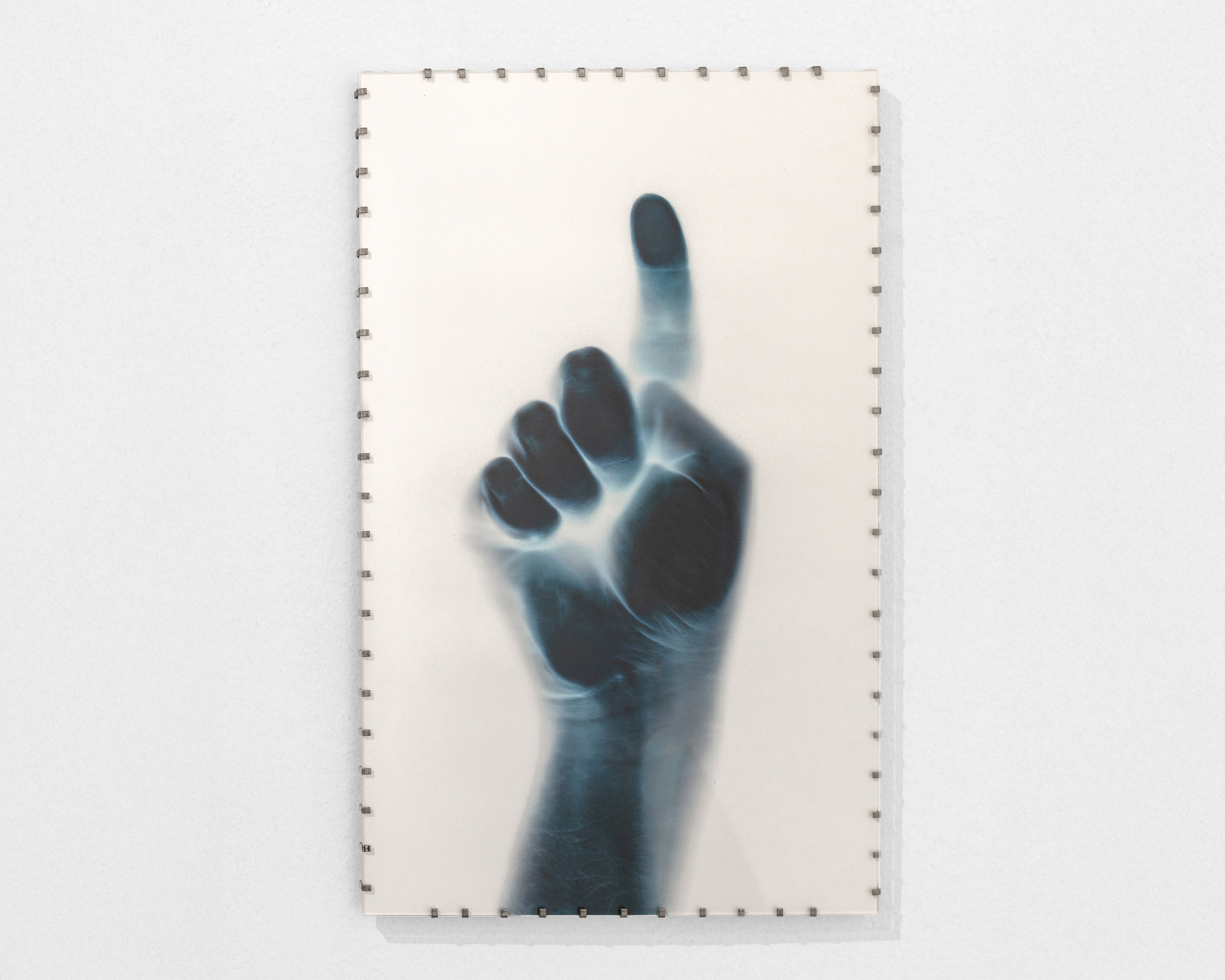
When Orpheus descended into the underworld, he convinced Hades to bring Eurydice back. The condition was that Orpheus had to walk ahead of her and couldn't look back until they were outside. This condition represents the limits of human ability and the impossibility of returning to the past.
 Shekel (2025)
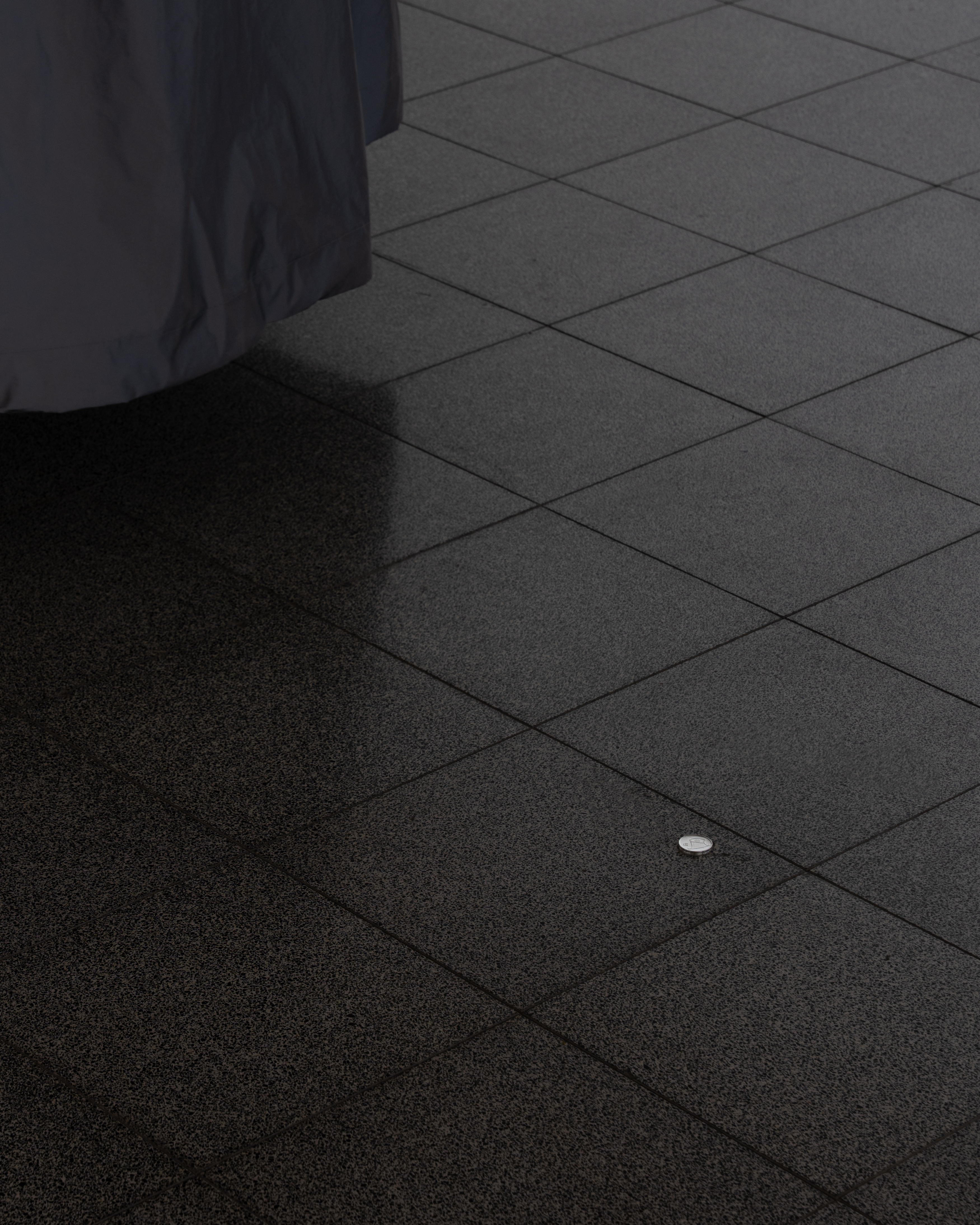
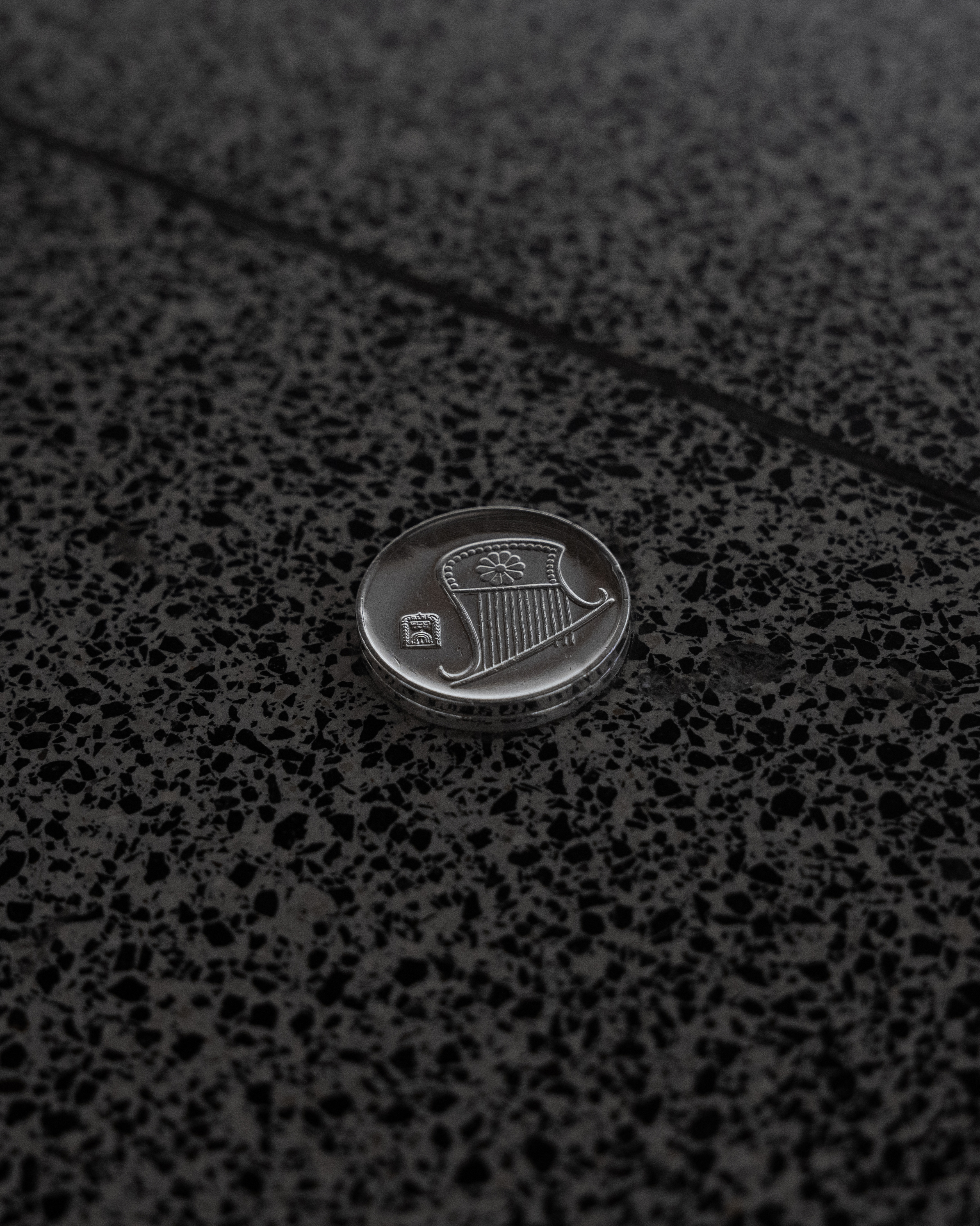
two silver plated half shekel coins
The Israeli half-shekel coin, though seemingly mundane, resonates with the myth of Orpheus and the ancient tradition of placing a coin in the mouth of the dead as payment to Charon for passage across the Styx. In this light, the half-shekel echoes Orpheus’s own negotiation at the threshold of death, where his music becomes a kind of currency—immaterial yet powerful enough to move the gods. The everyday coin thus acquires a mythological dimension, symbolizing not only economic value but also the possibility of crossing boundaries and confronting the ineffable.
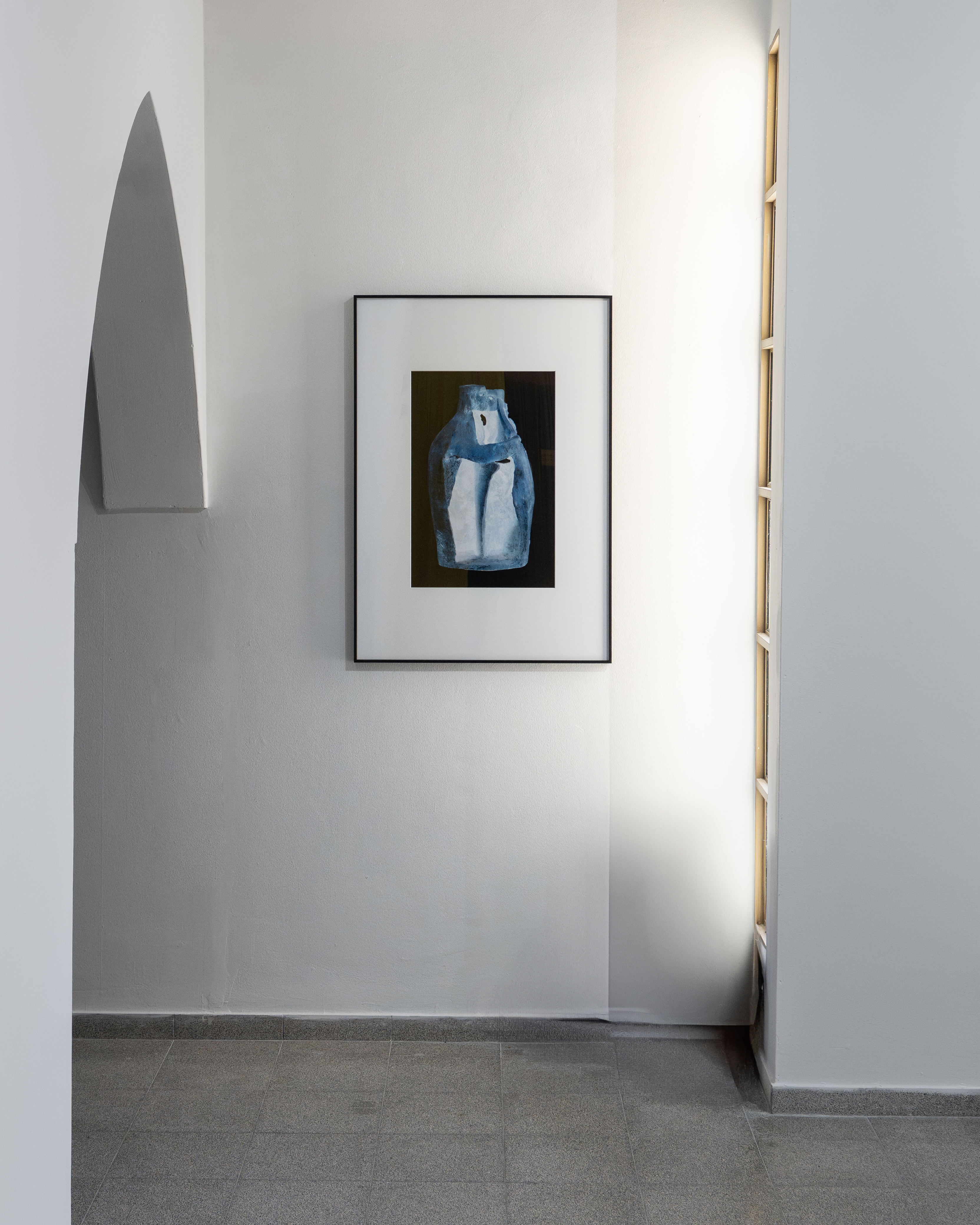
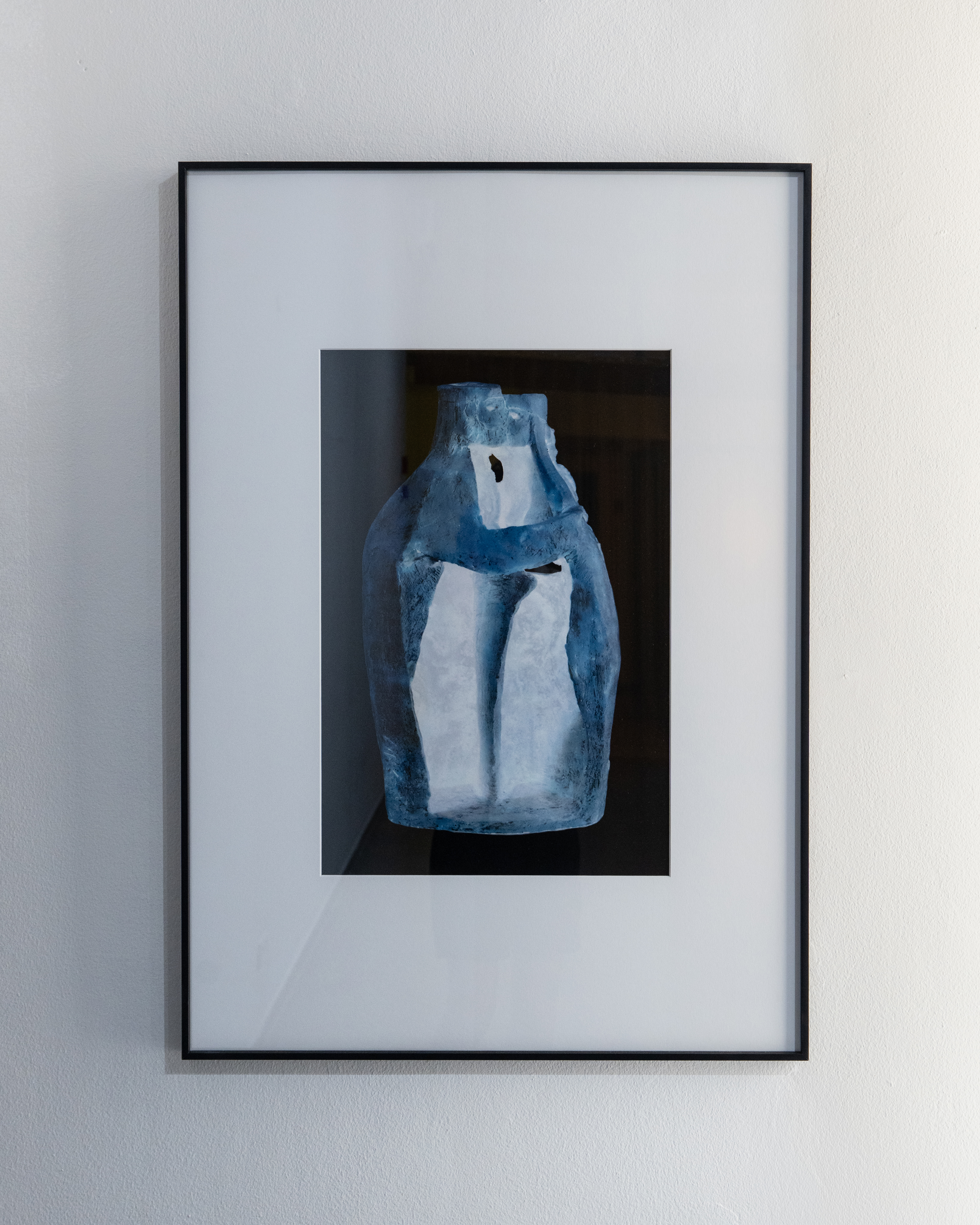 Hug (2025)
printed on paper, 100 x 70 cm
The work presents a negative photograph of Nahum Gutman’s sculpture of an embracing couple, from which light emerges. The photographic inversion transforms a gesture of intimacy into a charged scene of memory and loss. The light breaking through the figures recalls the myth of Orpheus, where music and radiance serve as forces that traverse boundaries between life and death, love and loss. The familiar image thus becomes a symbol of the human longing for union, marked by an irreparable fracture within its very illumination.
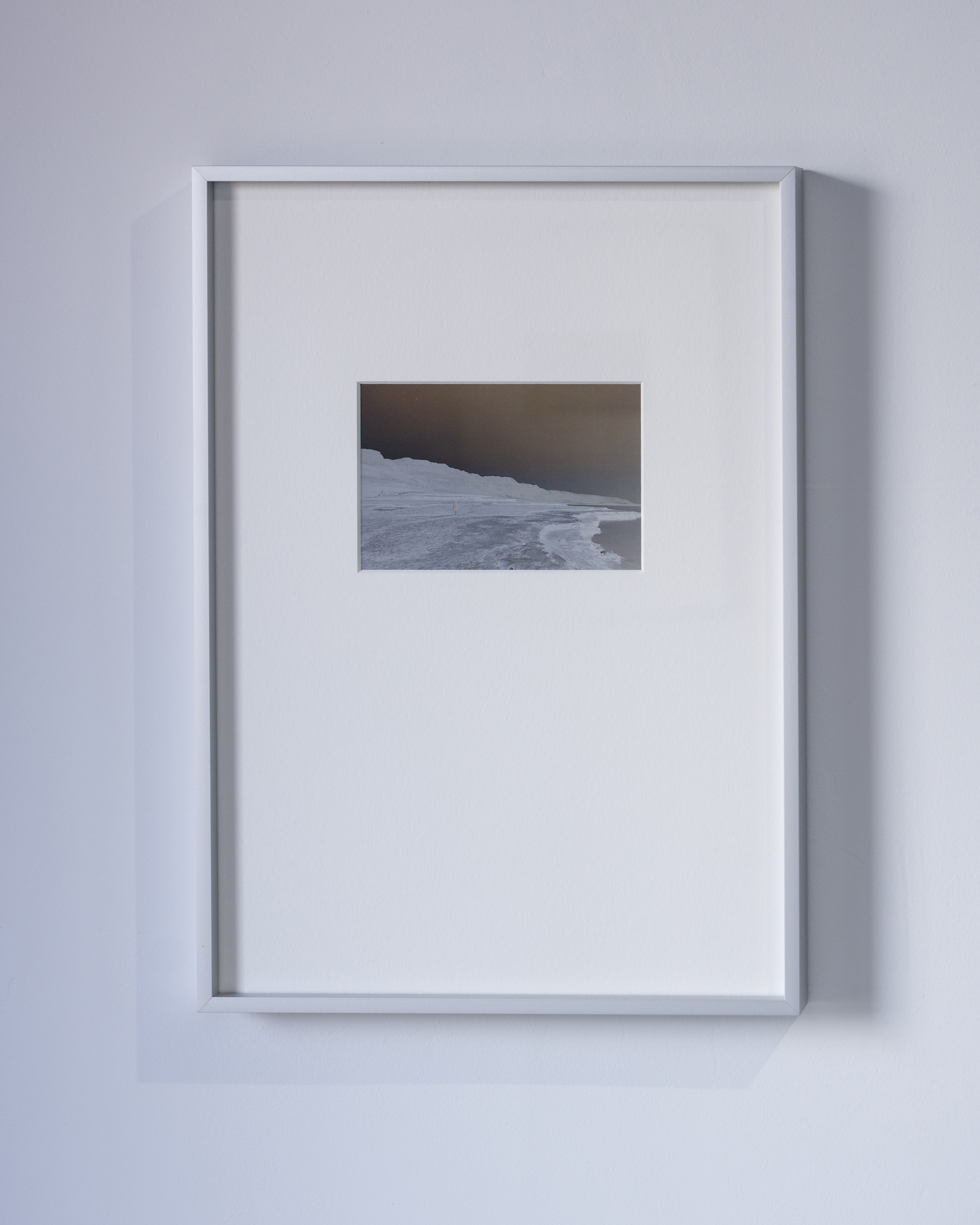
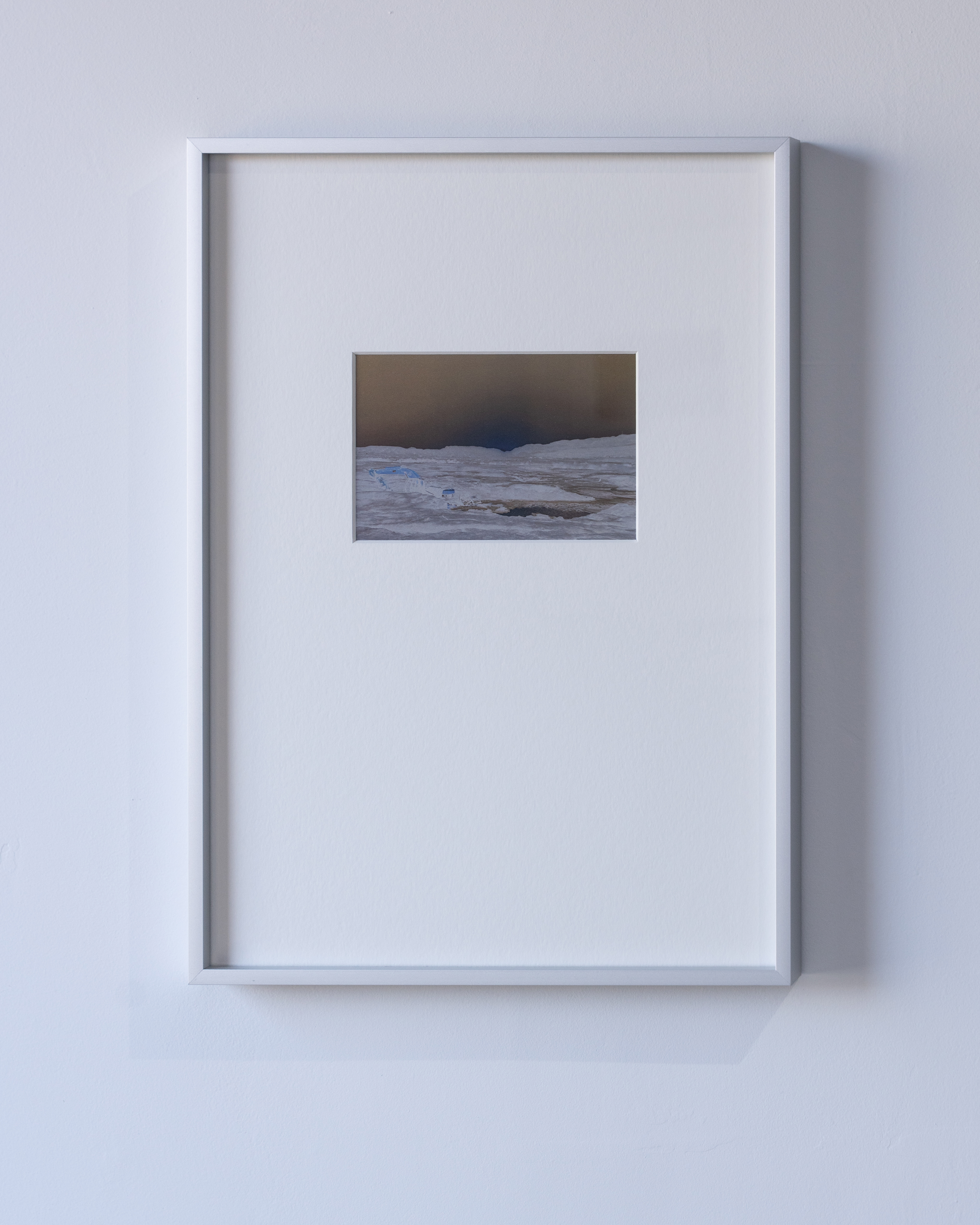 A&B (2025)
printing on silver paper, 42 x 30 cm
The two photographs capture the sunset over the Dead Sea, printed on silver paper that reflects and amplifies the natural glow. The metallic surface enhances the fleeting quality of light, transforming the images as the viewer moves.
Because of the Wind (2025)
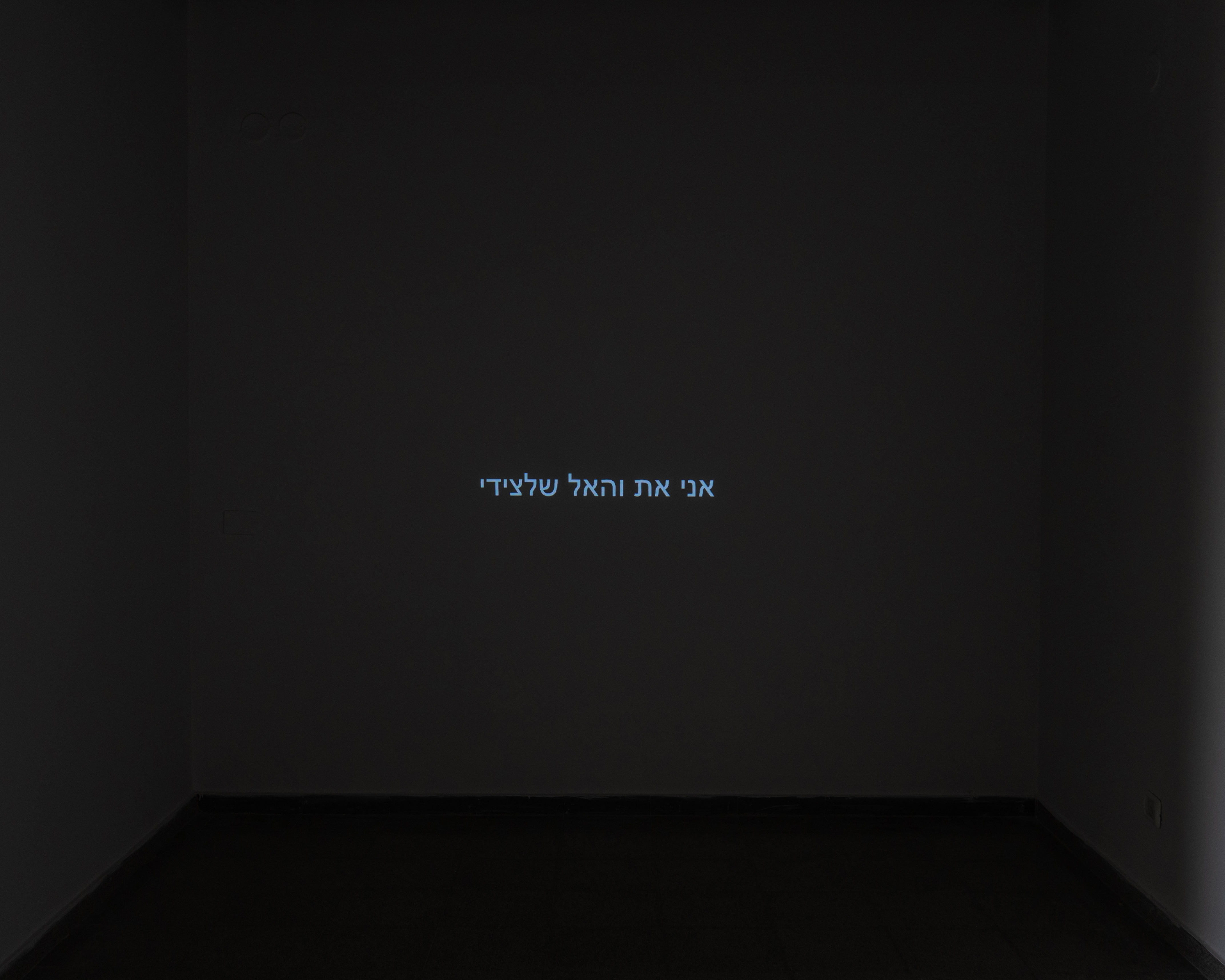
video loop, 2:23 minutes
The song “Because of the Wind” by Micha Shitrit, written in the early 1990s, expresses a persistent movement forward in the face of obstacles and uncertainty. The lyrical voice surrenders to an external internal force “the wind” which simultaneously embodies an uncontrollable element of nature and a metaphor for the muse, for faith, and for the power of creation.
In comparison with the myth of Orpheus, a fundamental parallel emerges: through his song, Orpheus penetrates the underworld and convinces the gods to return his beloved Eurydice. Yet his journey collapses in a moment of doubt, when he turns back to look at her. In the song, as in the myth, there is a tension between unwavering determination and the temptation of failure, between moving forward and the impulse to look back.
︎︎︎ Video documentation
NonFinito
Nonfinito (2025)
Artport, Tel Aviv
artists-in-residence group exhibition
Curator: Vardit Gross
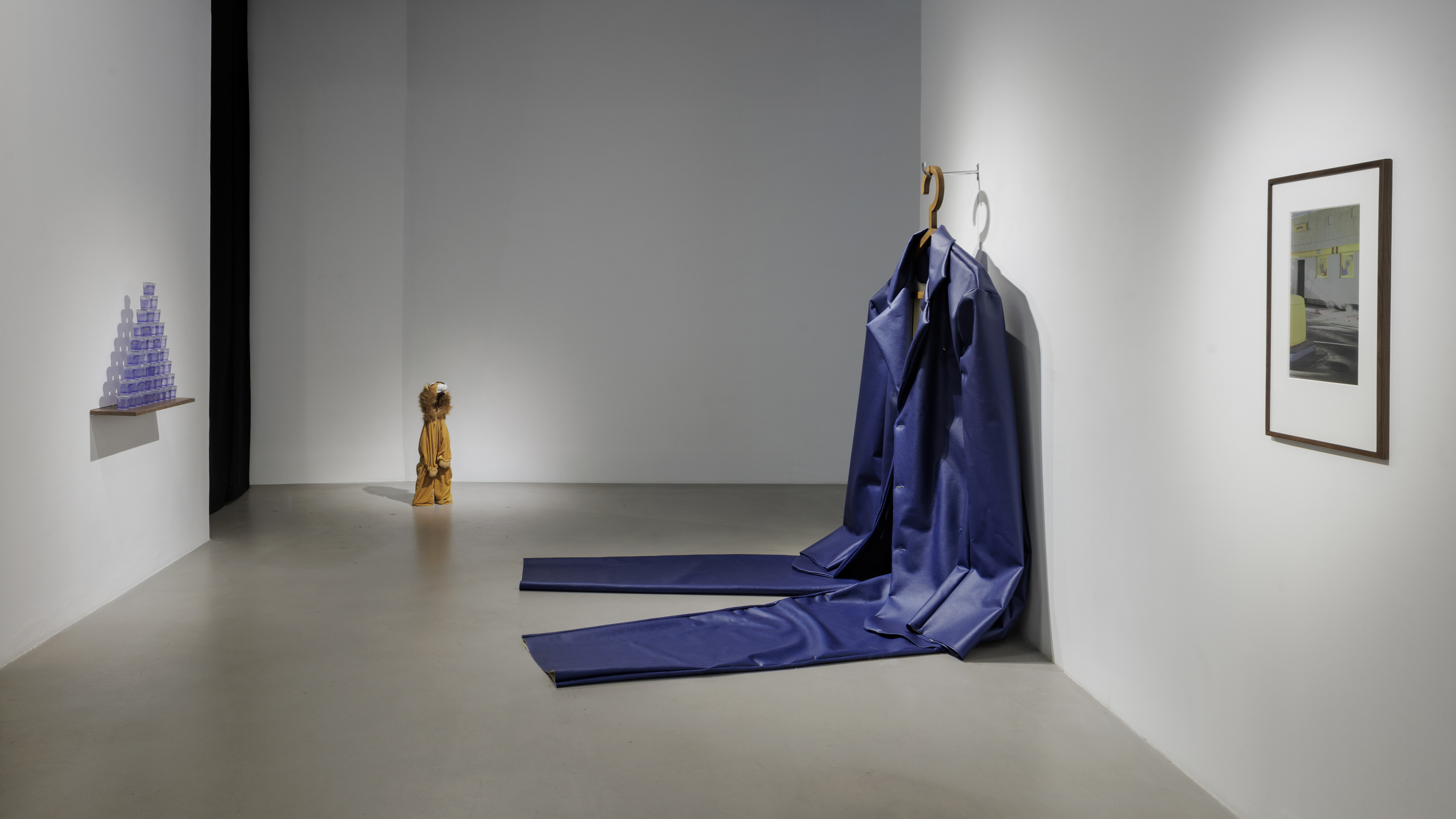
In the body of work I presented in the exhibition, I focused on materials collected in south Tel Aviv, in the immediate surroundings of Artport. Daily walks through the neighborhood became a ritual of collecting, editing, and marking. Along the way, fragments of economy, culture, and urban routine accumulated objects charged with human gestures and traces of repeated use.
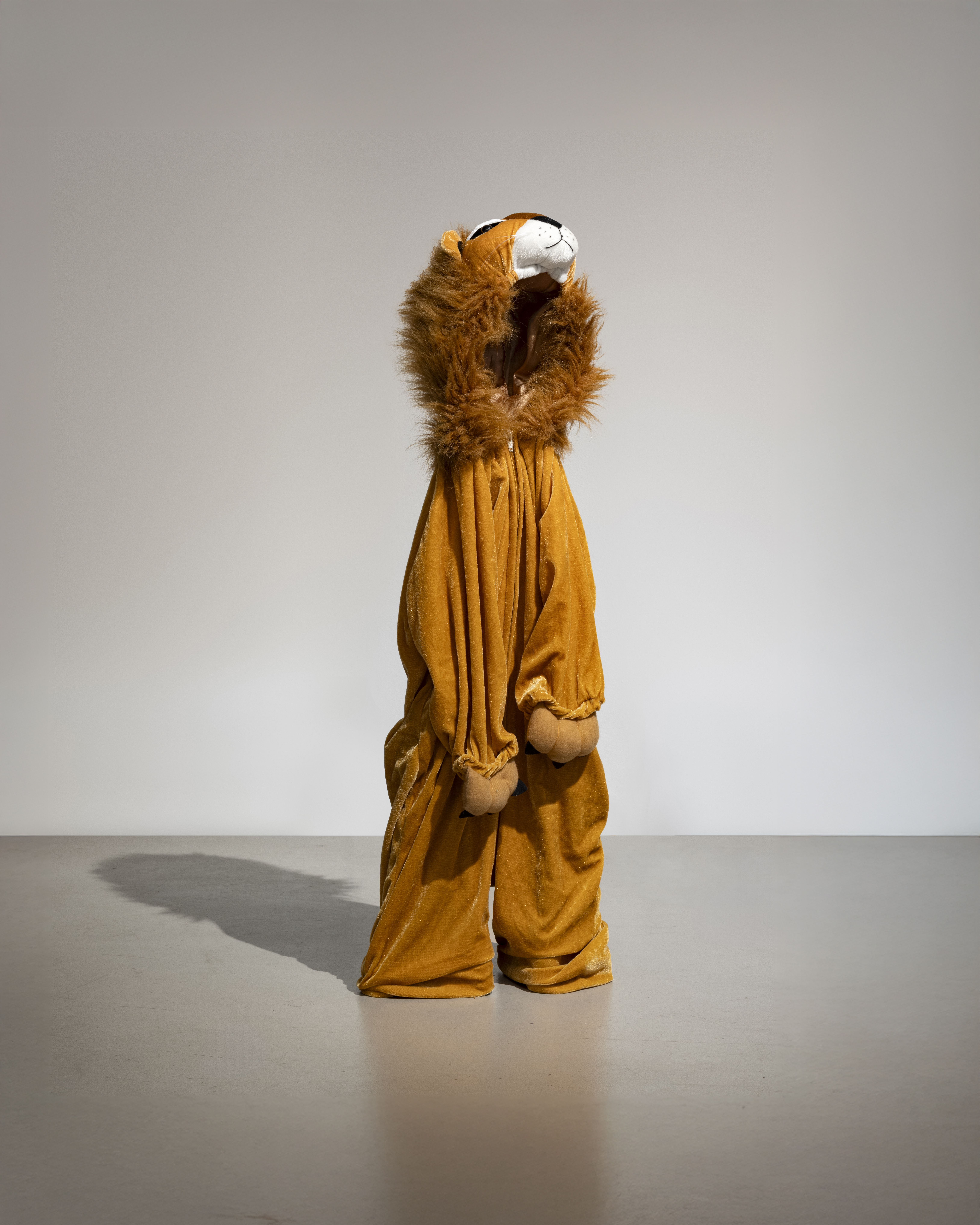
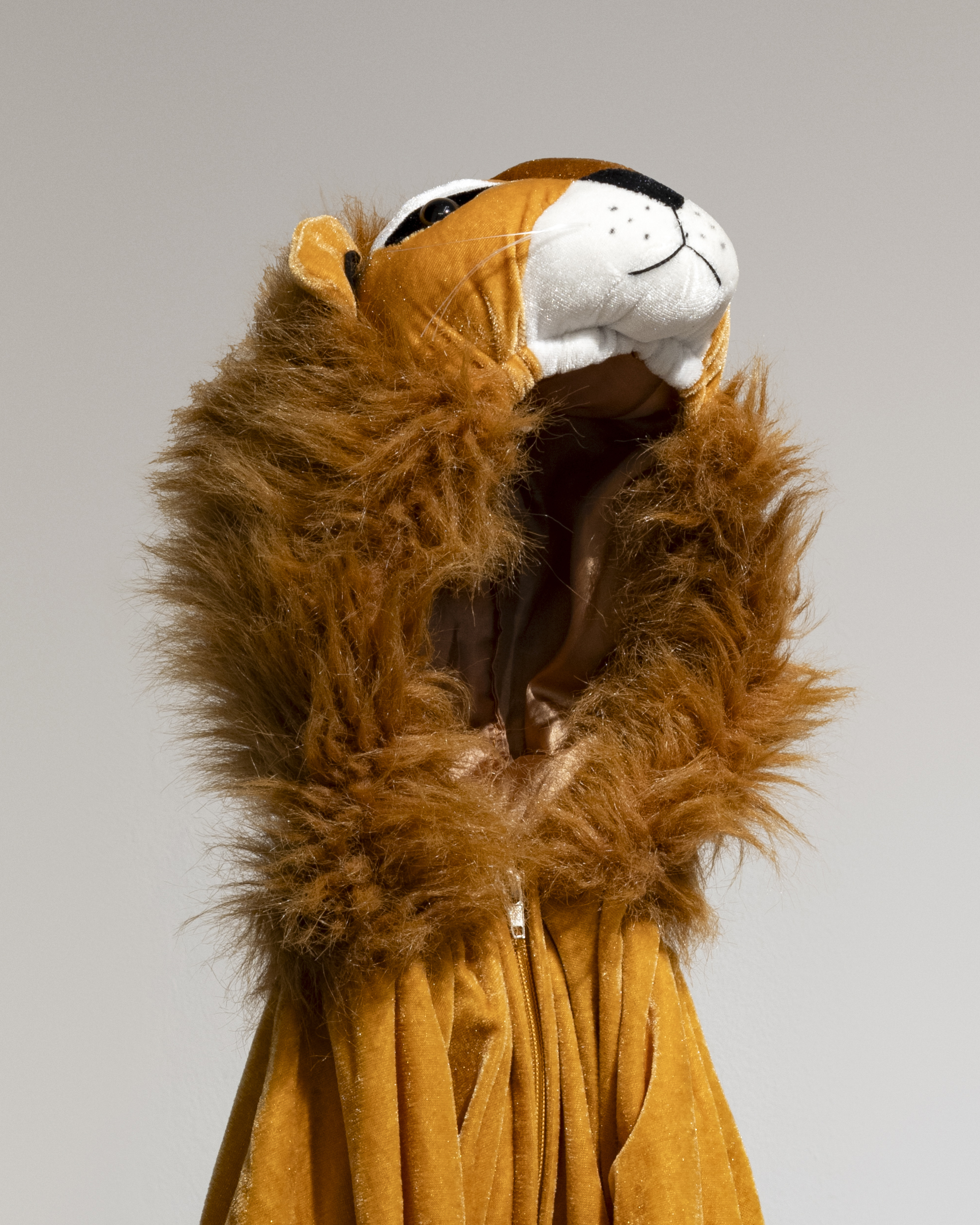
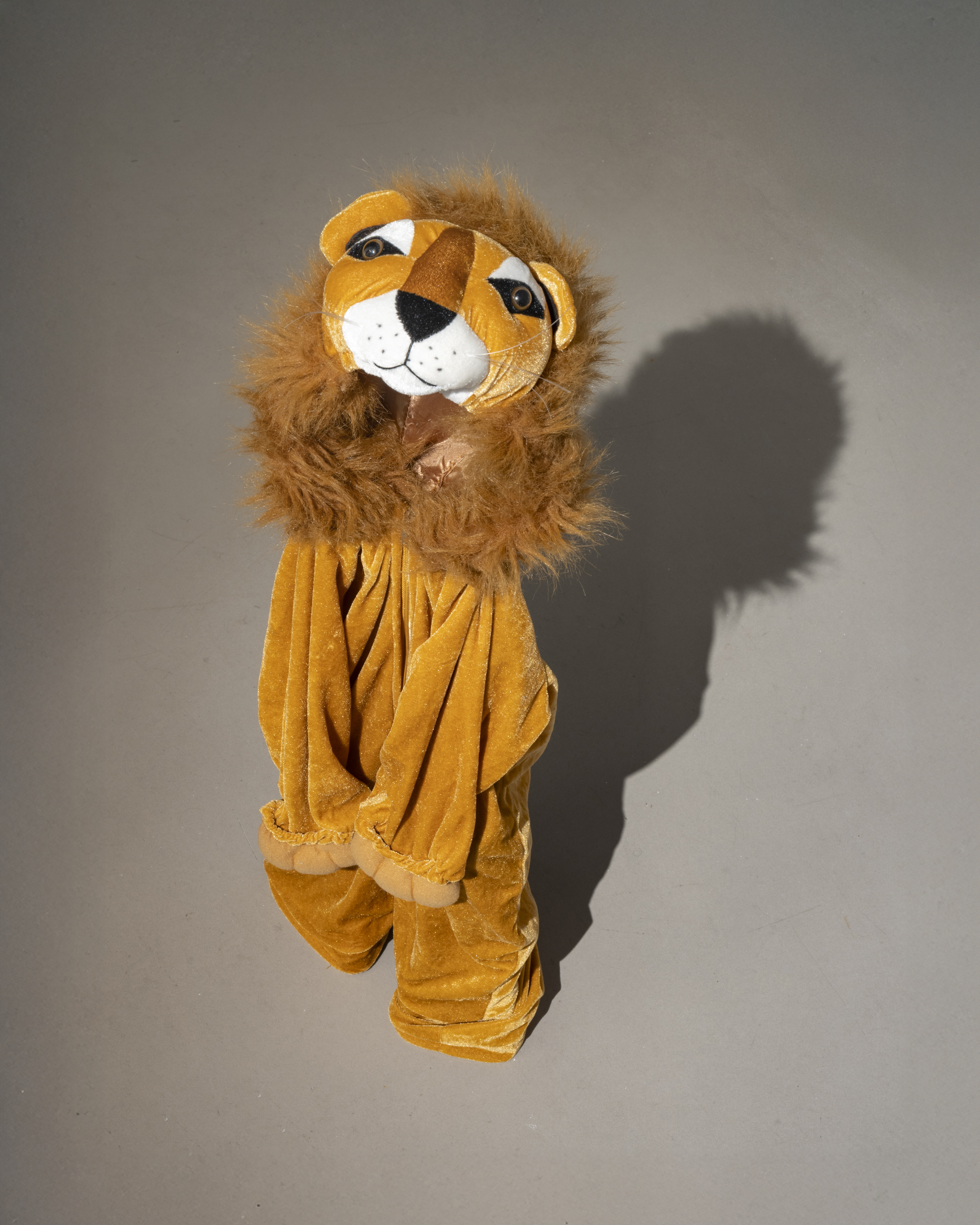
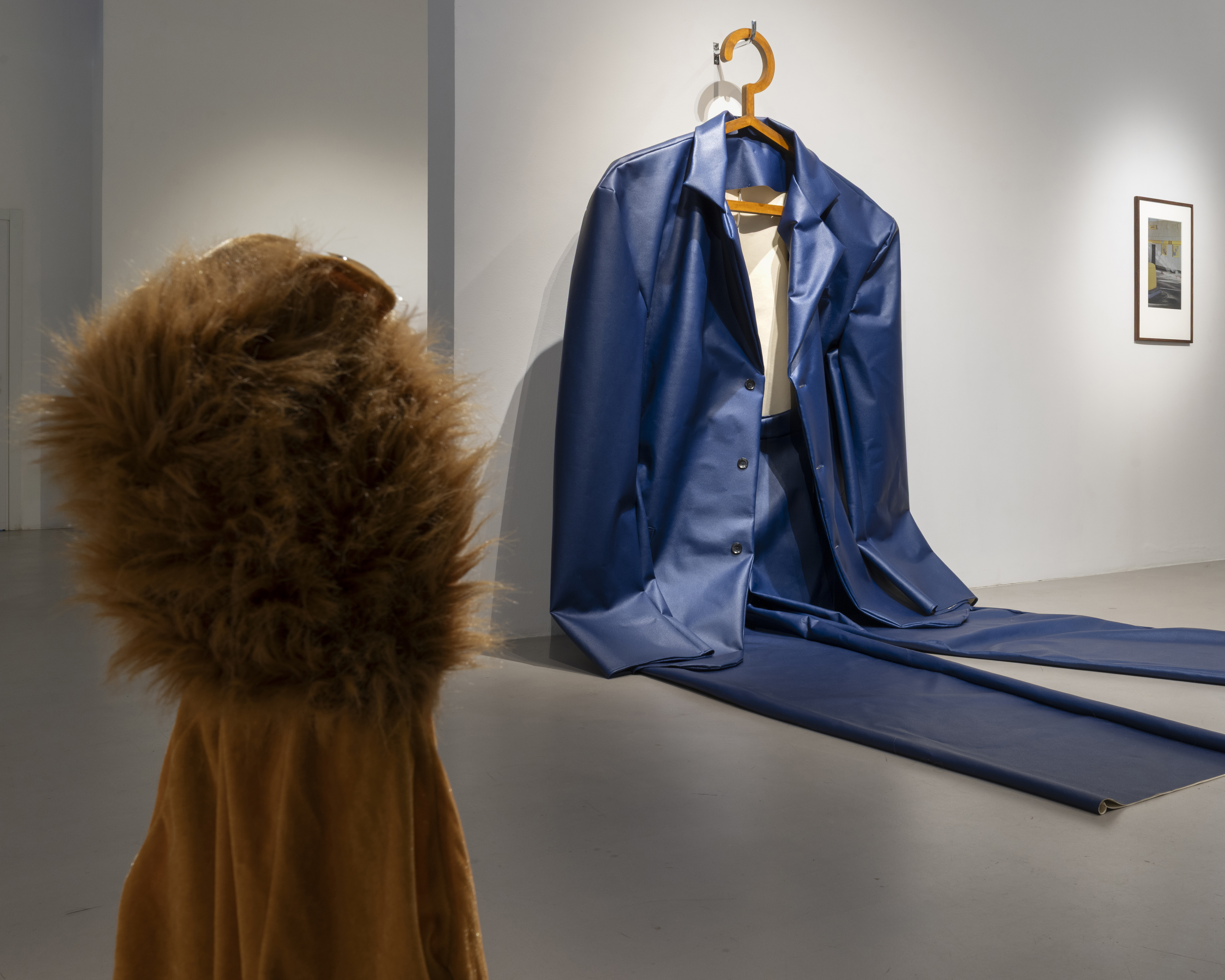
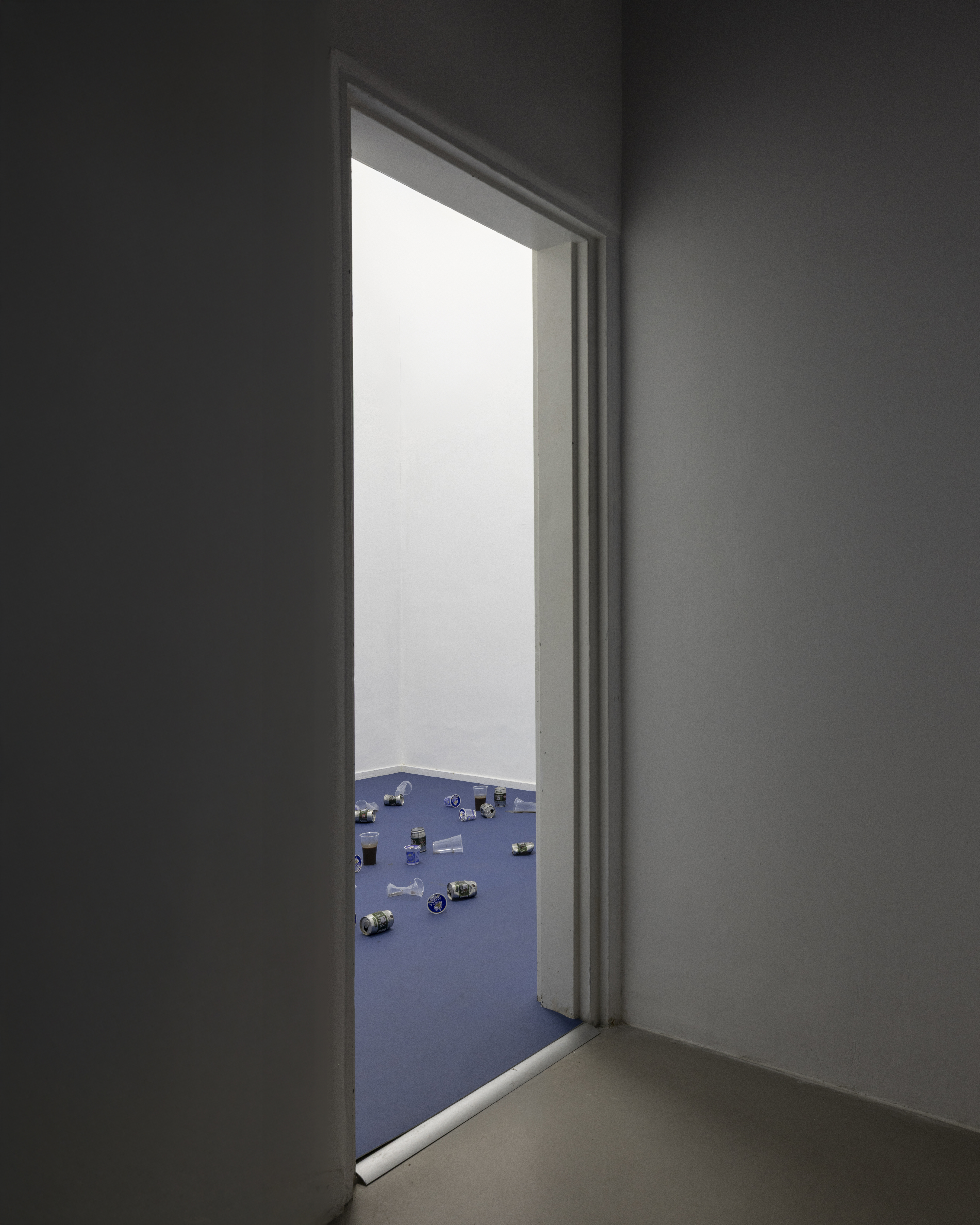
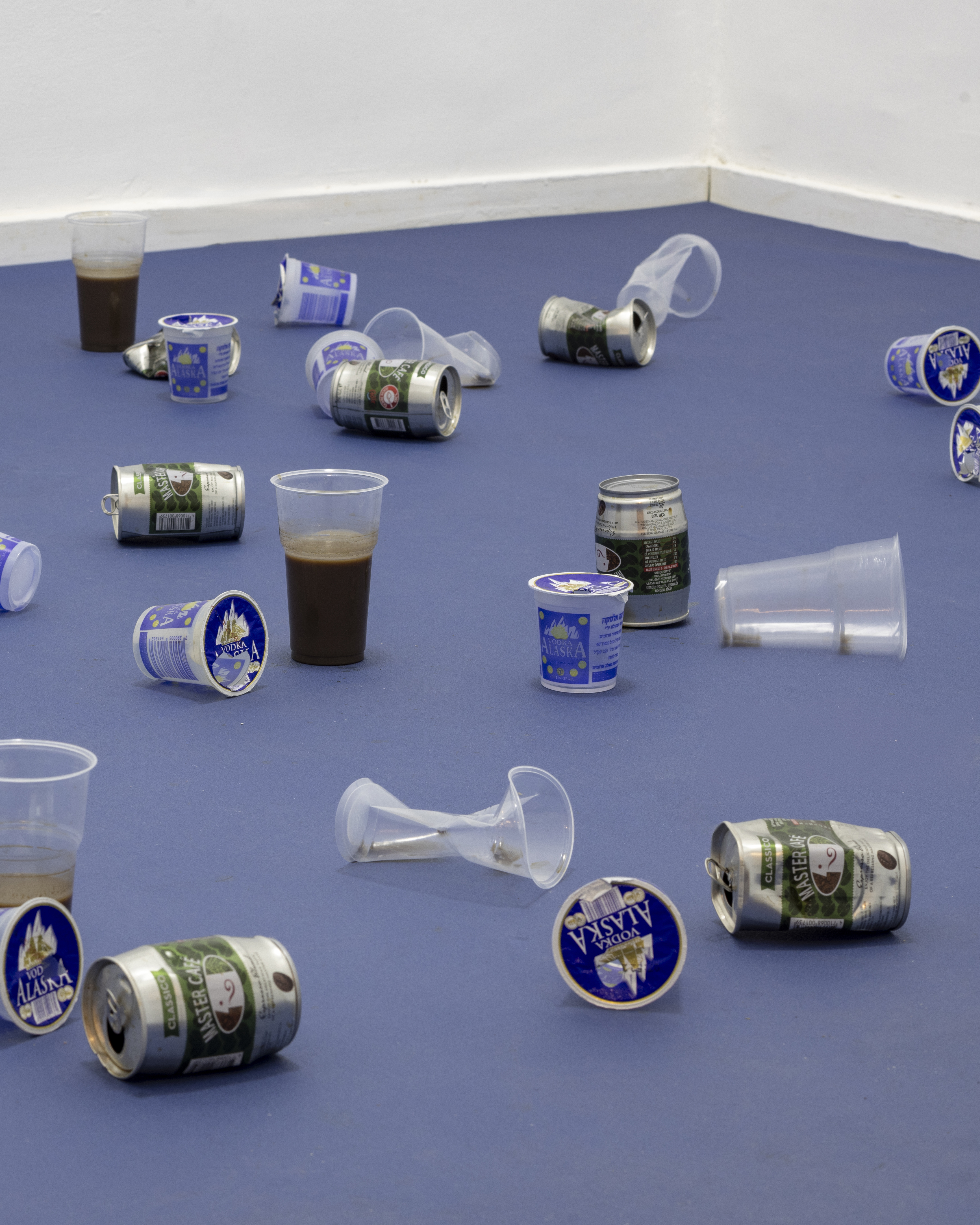
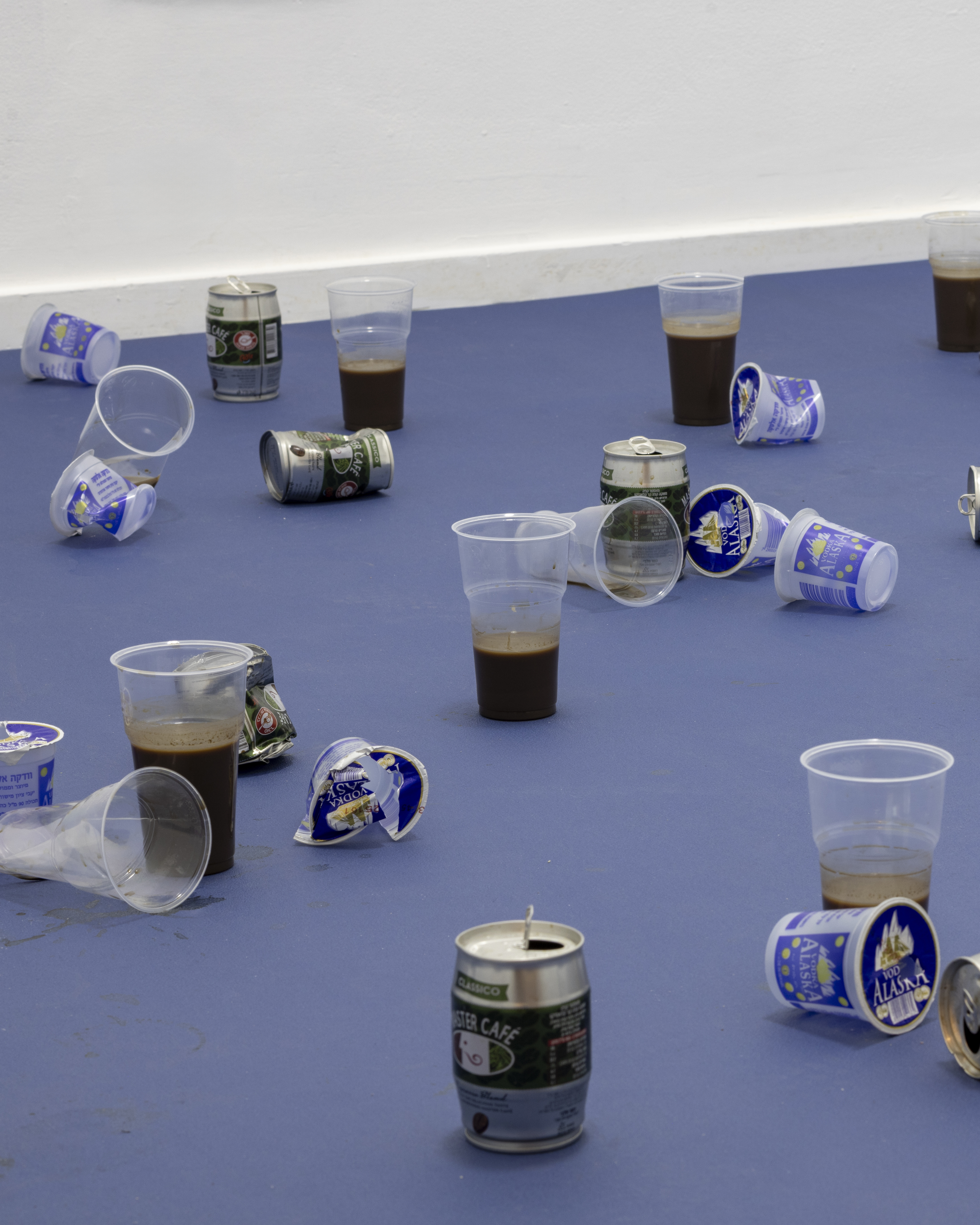
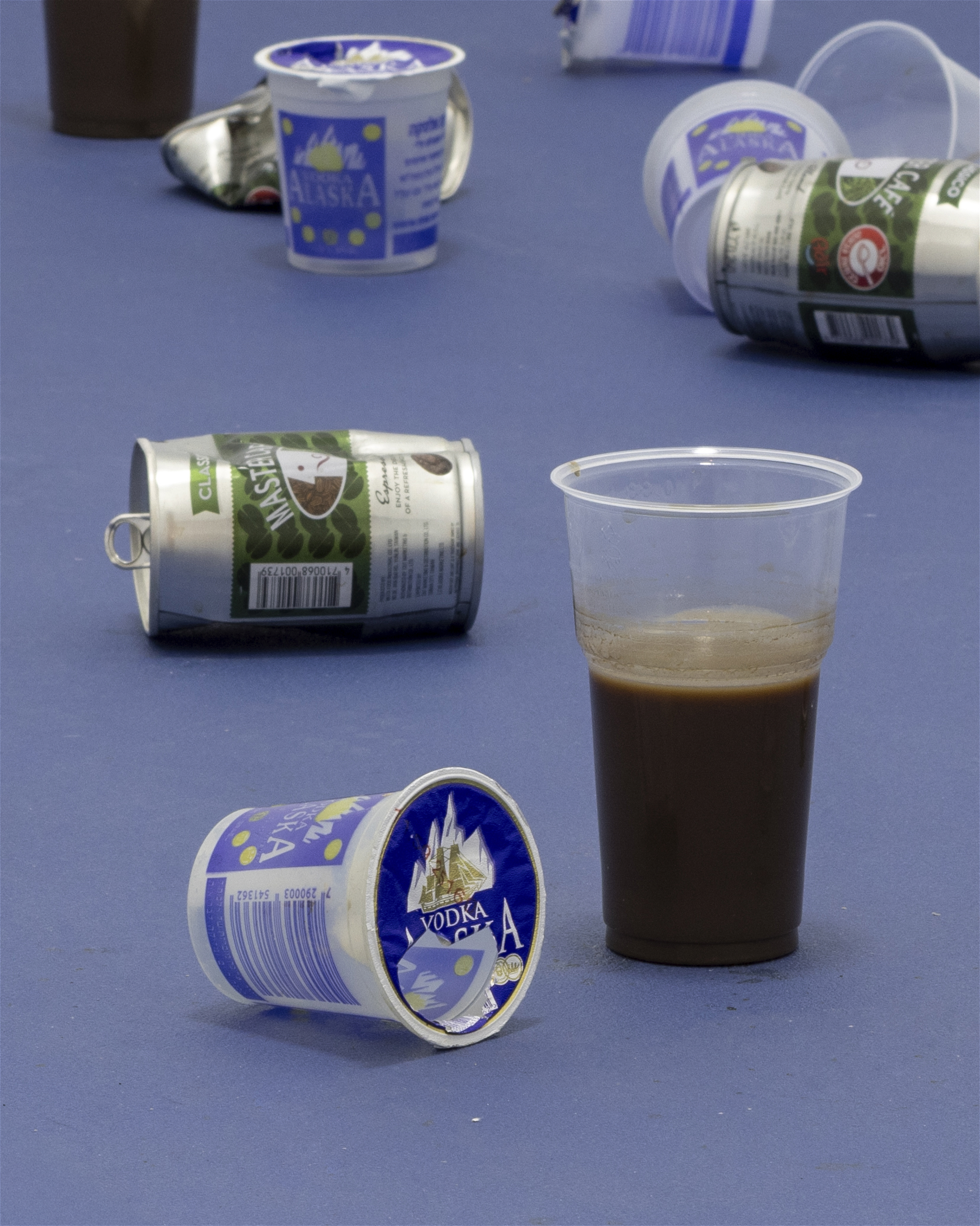
Near a food distribution point for people experiencing homelessness, disposable “Alaska Vodka” cups were gathered and stacked into a tower of promises. Combined with “Master Coffee” cans, they formed an “Espresso Martini” a south Tel Aviv version of a familiar cocktail. A child’s lion costume, found discarded on the street, was mounted on two microphone stands, emphasizing the fragility of the figure, the body, and the position of the artist. In The Politician, an oversized suit sewn from blue linoleum a material commonly associated with industrial and public flooring appears to have lost its strength and collapsed onto the floor.
These remnants of consumption do not enter the exhibition space as waste, but as active collaborators in the work. They carry traces of use, exhaustion, and promise, becoming an echo of the urban environment and of everyday human actions.
Installation views by Tal Nisim
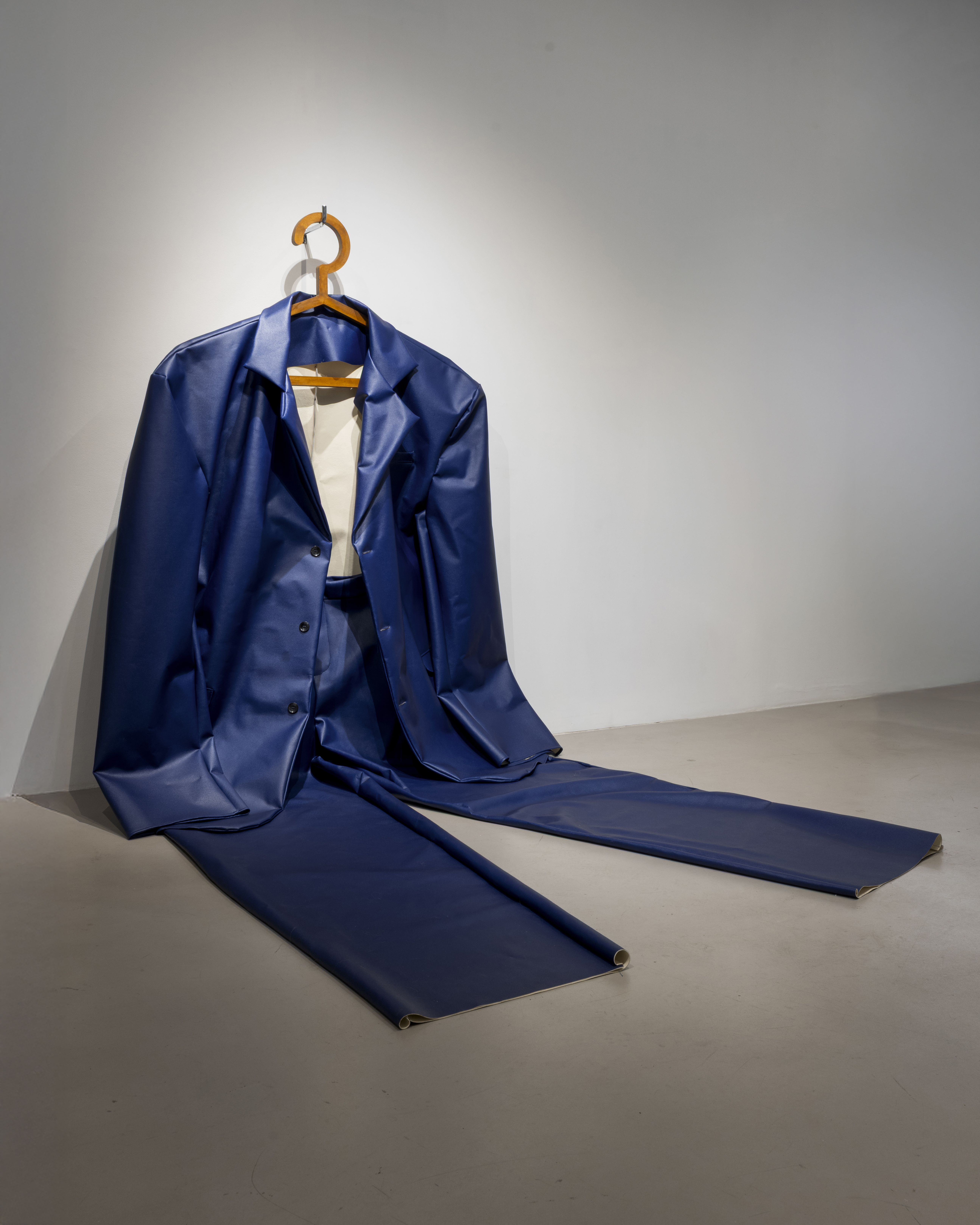
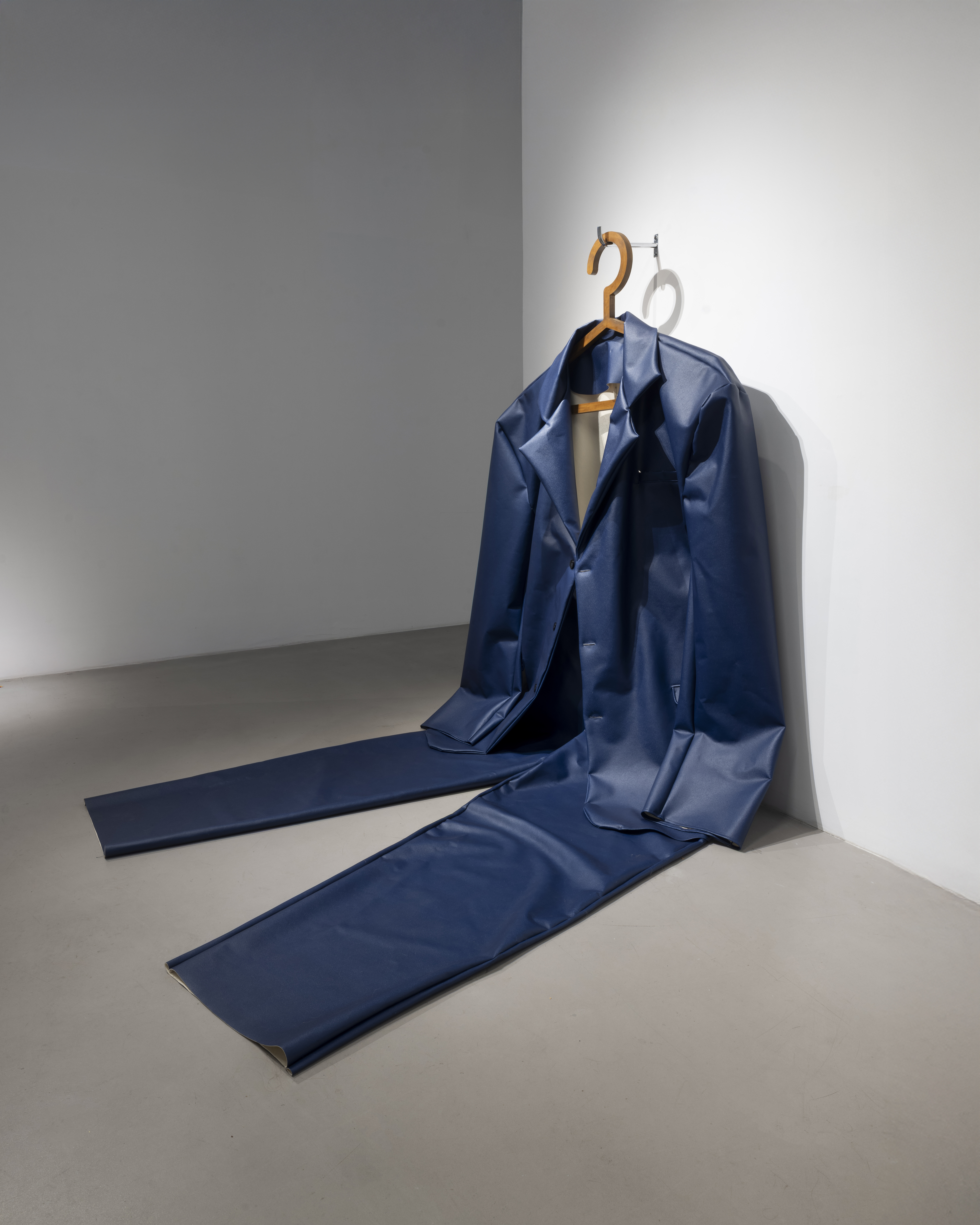
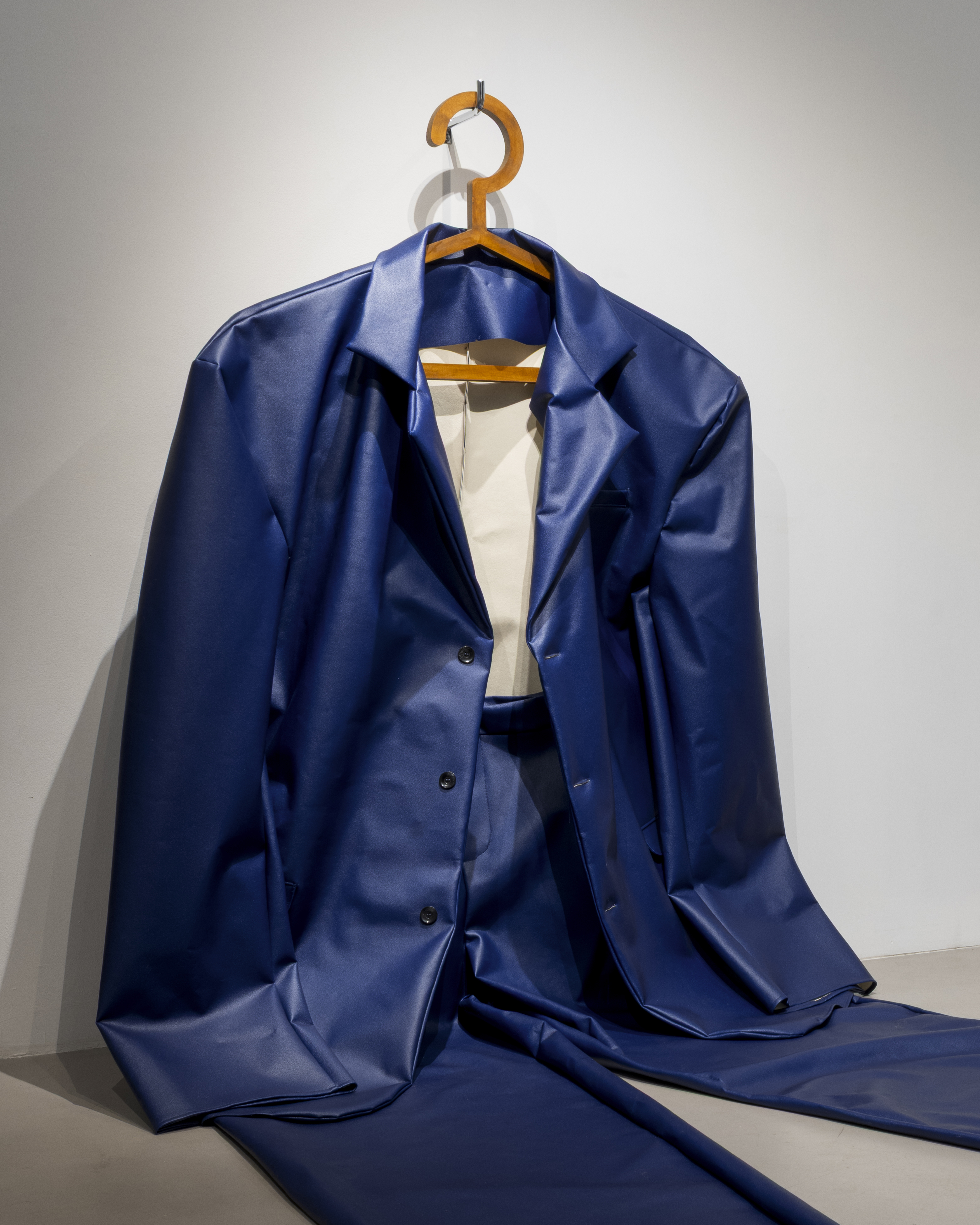
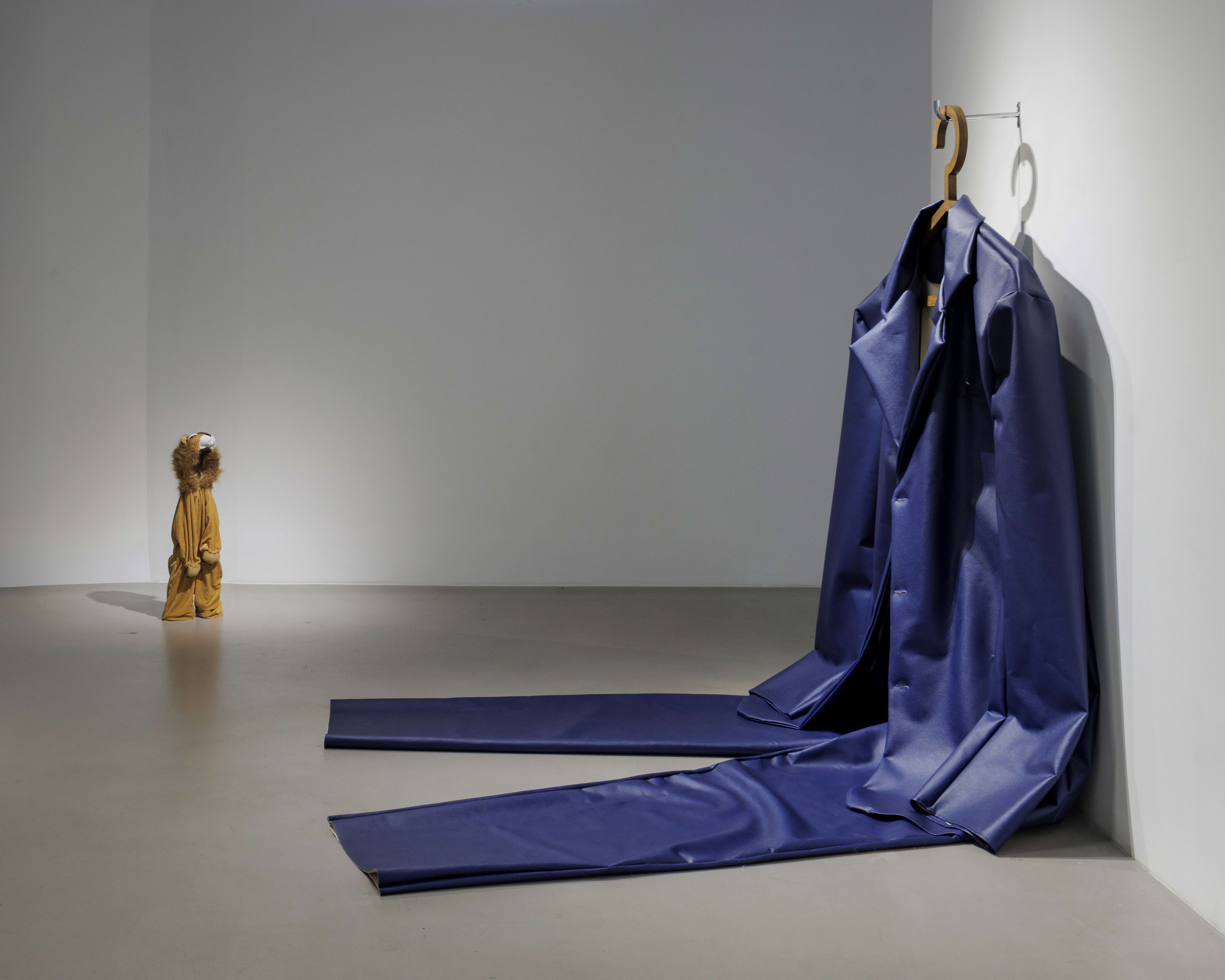
Politician, 2025
Linoleum, plywood
Politician is an oversized suit made of dark blue linoleum. The garment is sewn from a material familiar from floor tiles and public spaces: industrial, durable, inexpensive, and never meant to touch the body. Its use replaces the softness and flexibility of fabric with a rigid, glossy surface that simulates presence while simultaneously erasing it.
 Esau, 2025
Child’s lion costume, microphone stands, steel wire
Esau presents an empty lion costume, standing o the floor like an abandoned body. The garment remains as a shell only. The lion, a symbol of courage and confidence, is rendered immaterial, shedding its meaning the moment the child is absent. The missing human body becomes the work’s focal point: the costume holds a memory of warmth and movement, yet stands as a silent witness to an identity that has slipped away. Like the biblical Esau, a figure wrapped in skin whose outward appearance becomes a site of impersonation, the work exposes the tension between inside and outside, between what is worn and what is left behind.
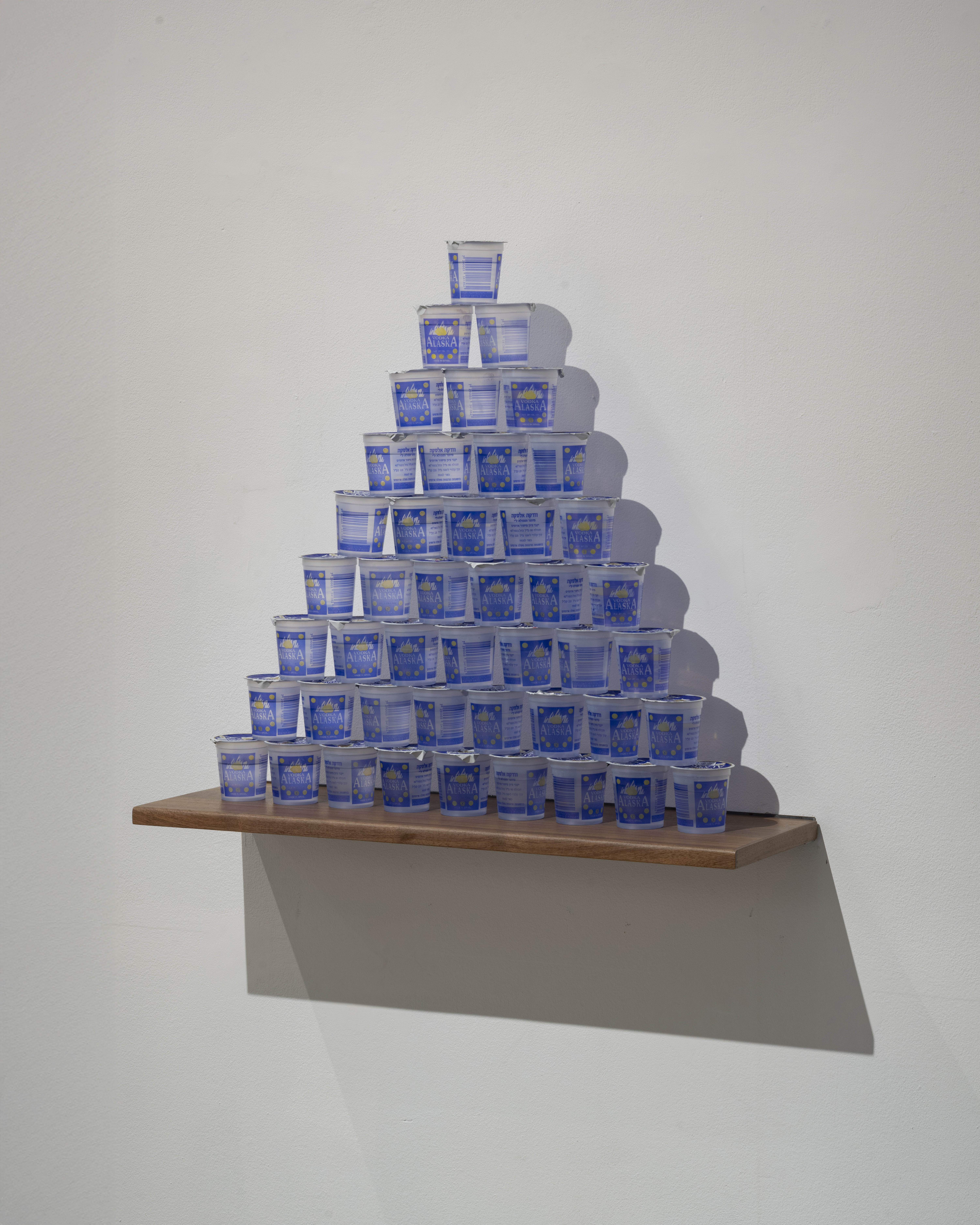
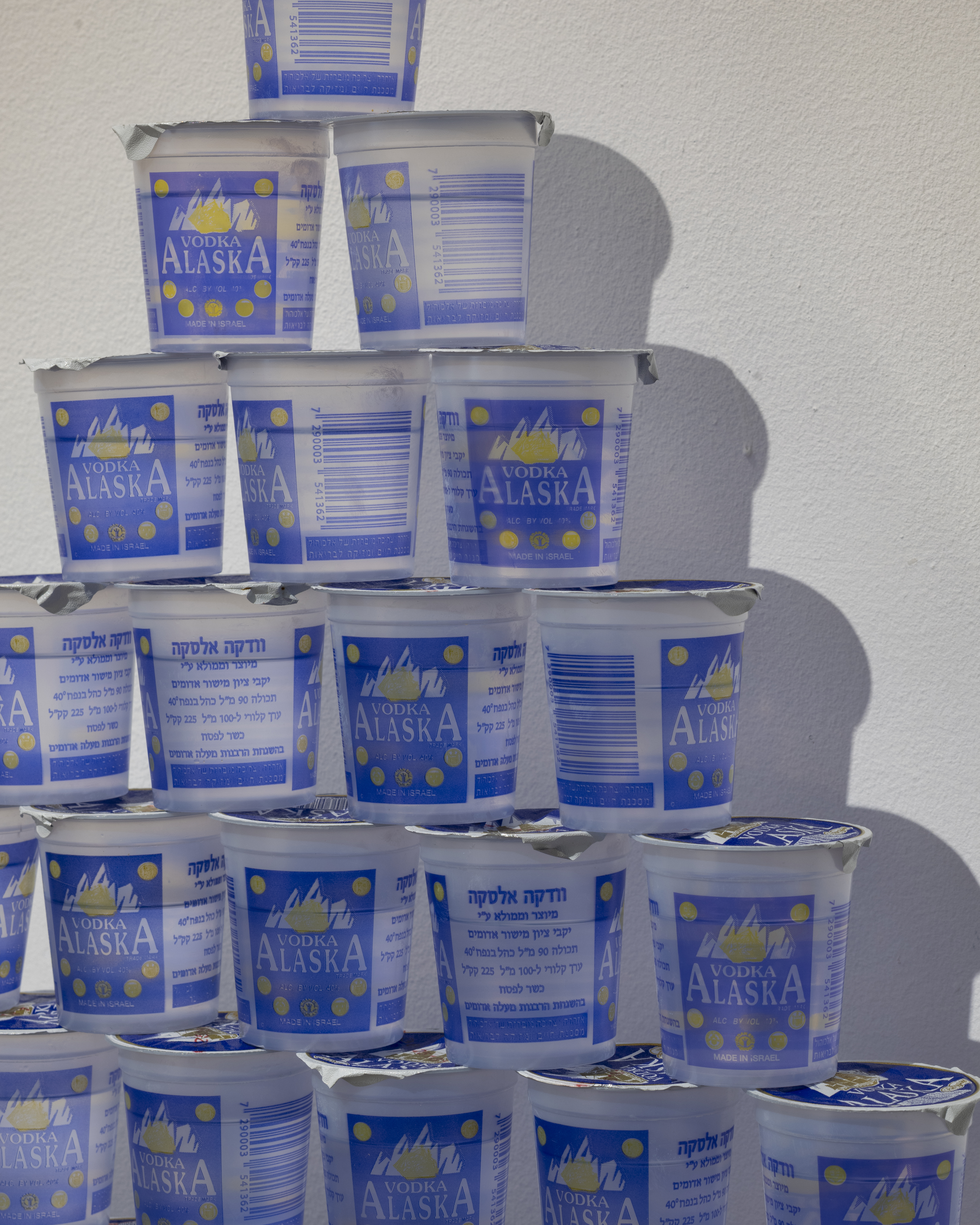
Alaska, 2025
Alaska vodka cups, wooden shelf
Forty five plastic cups of “Alaska” vodka are stacked into a stable yet fragile pyramidal structure, a kind of temporary monument to the cheapest and most accessible substance on the margins. The vodka, produced in Mishor Adumim and sold in corner shops, marks a charged encounter between local economy, low-cost production, and the appearance of luxury.
The work examines the gap between the name “Alaska,” an image of distance, purity, and escapism, and a reality of poverty, dependence, and everyday consumption. The stack, echoing towers, temples, or pyramids of success, functions as an inverted symbol: a precarious structure built from a temporary material that stands only as long as no one touches it.
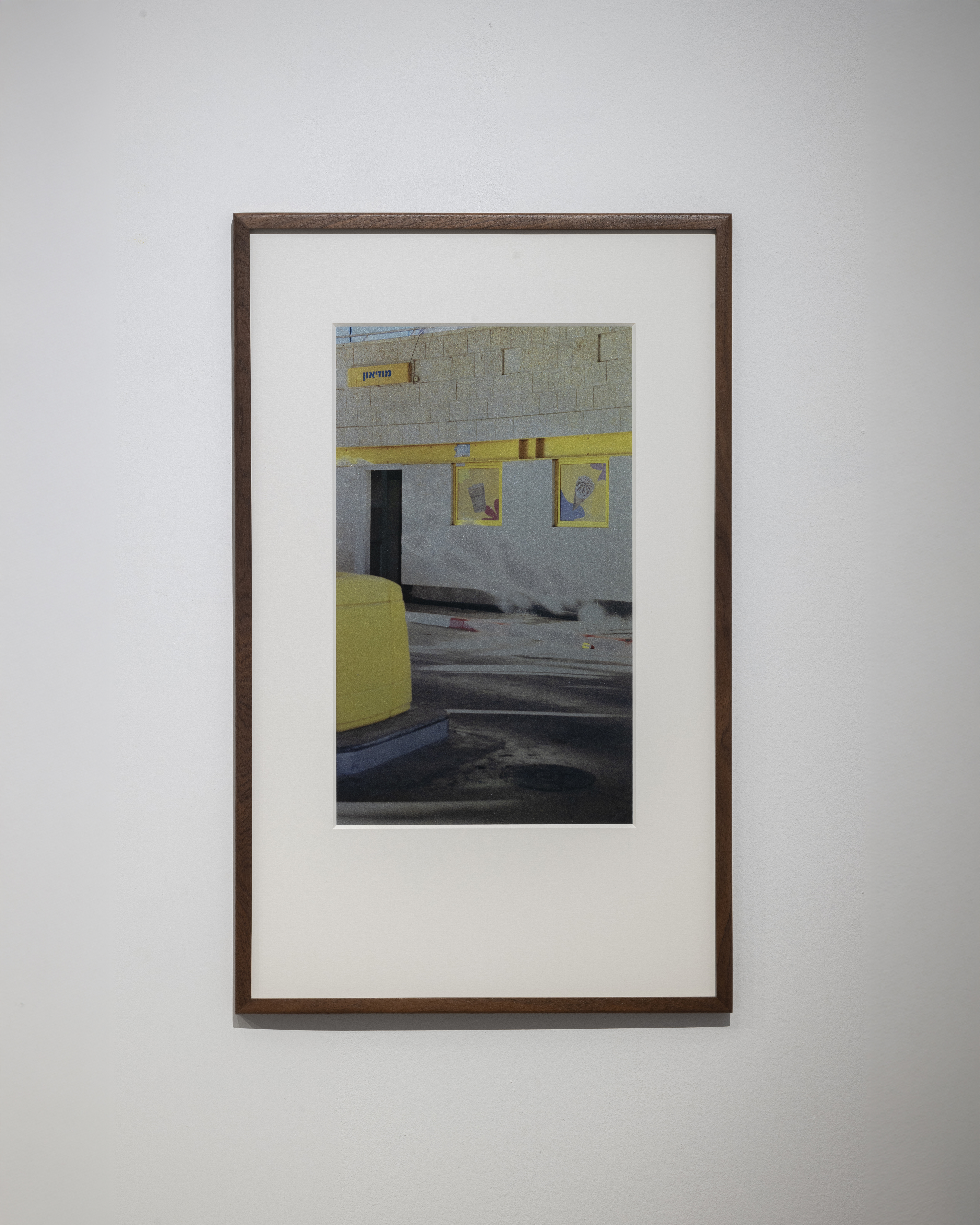
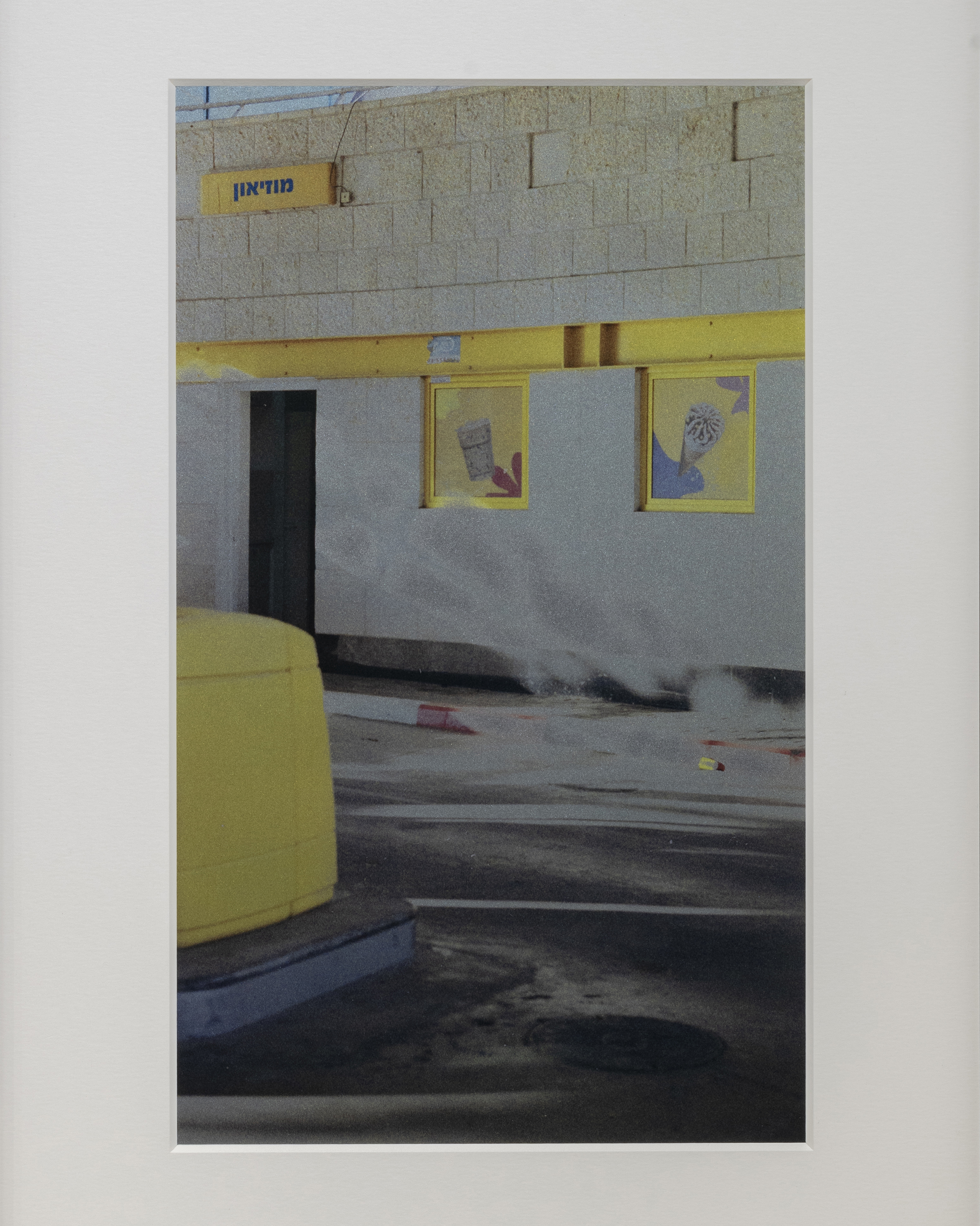 Museum, 2025
Digital print on silver paper, 70 × 40 cm
“Museum” is a photograph of gas stations located near the Israel Museum, printed on reflective silver paper. The choice of the shimmering material gives the image an almost collectible appearance, like a rare parchment, and shifts attention away from the everyday landscape toward the ways in which images
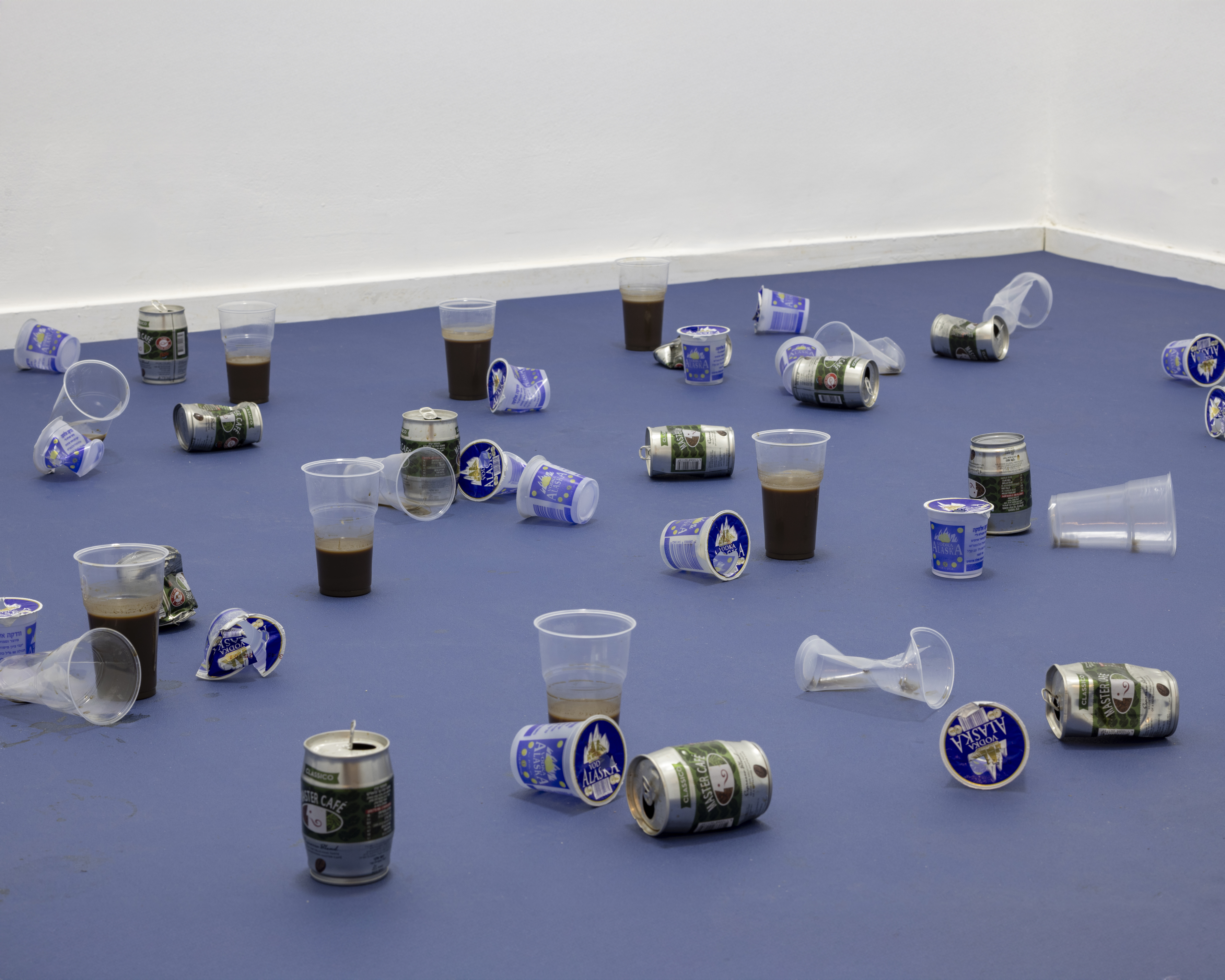 Espresso Martini, 2025
Alaska vodka cups, Master Café cans, plastic cups, linoleum
Plastic cups of “Alaska” vodka and “Master Café” cans scattered across a blue linoleum floor a reflection on the gap between image and reality, between fantasy and the urban everyday of exhaustion, survival, and an imagined sense of style.
Spectacular Failure
Spectacular Failure (2025)
CCA, Tel Aviv
Curator: Tamar Margalit

“Spectacular Failure,” CCA Tel Aviv-Yafo’s annual group exhibition, examines the significant role that failure – losing, coming up short – has played in Israeli art over the past fifty years. At a time when we are bombarded with slogans of 'Total Victory’ and ‘Together We Will Win,’ this preoccupation has become especially poignant. The participating artists don’t abandon the playground-like dichotomy of winning and losing, but rather undermine it from within, by identifying with the losing side.spells "SOS".
Text by Tamar Margalit
Installation views by Elad Sarig

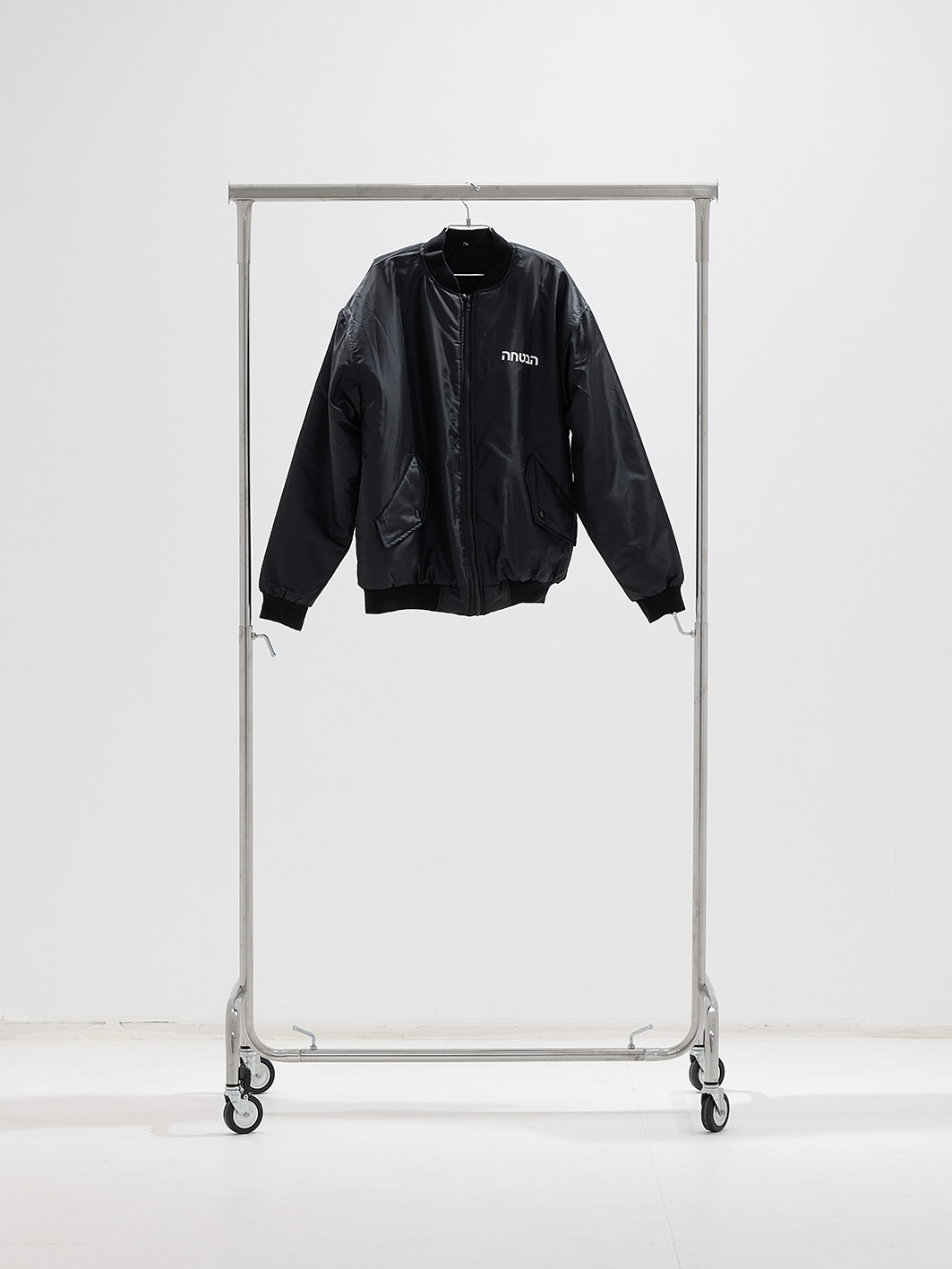
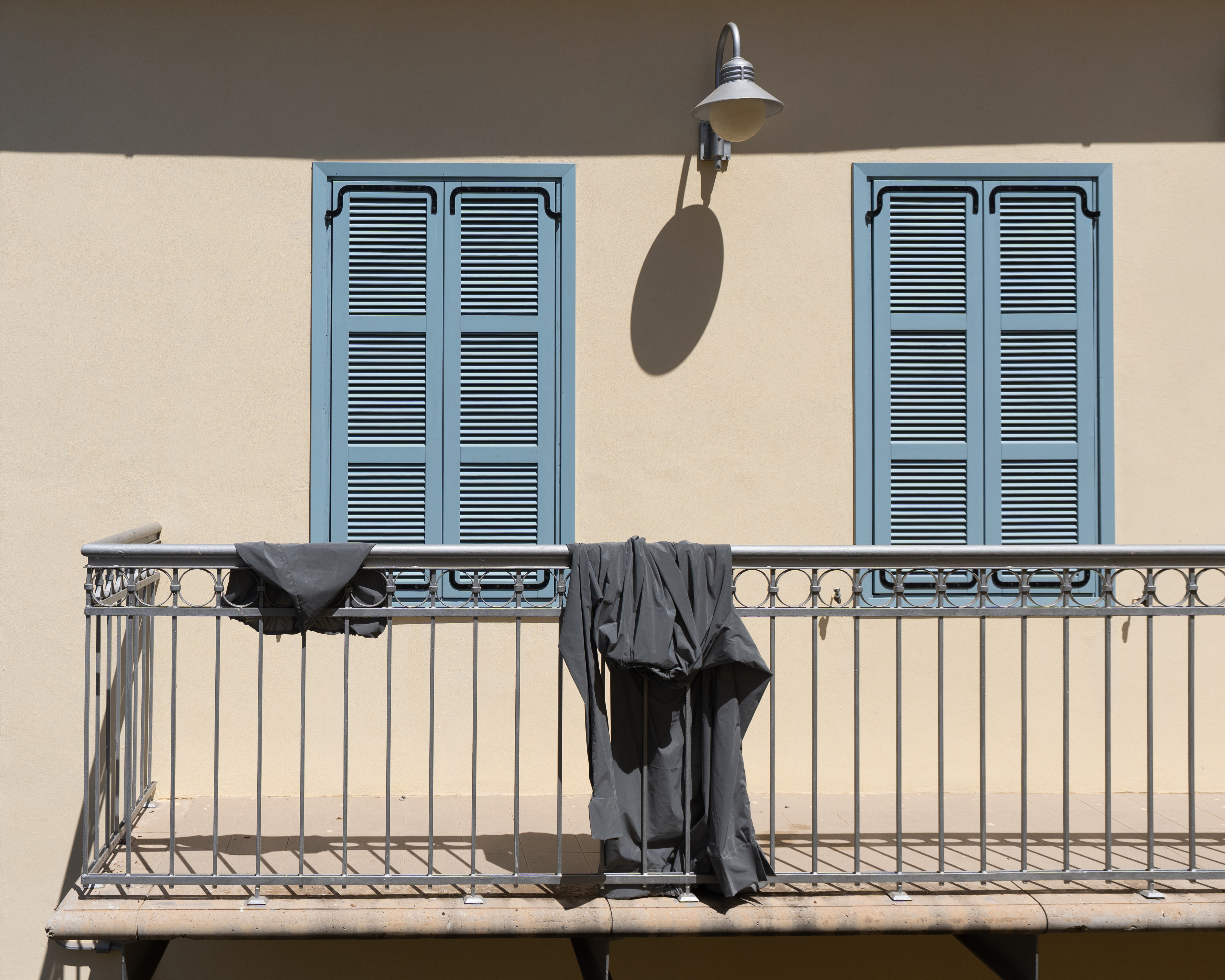
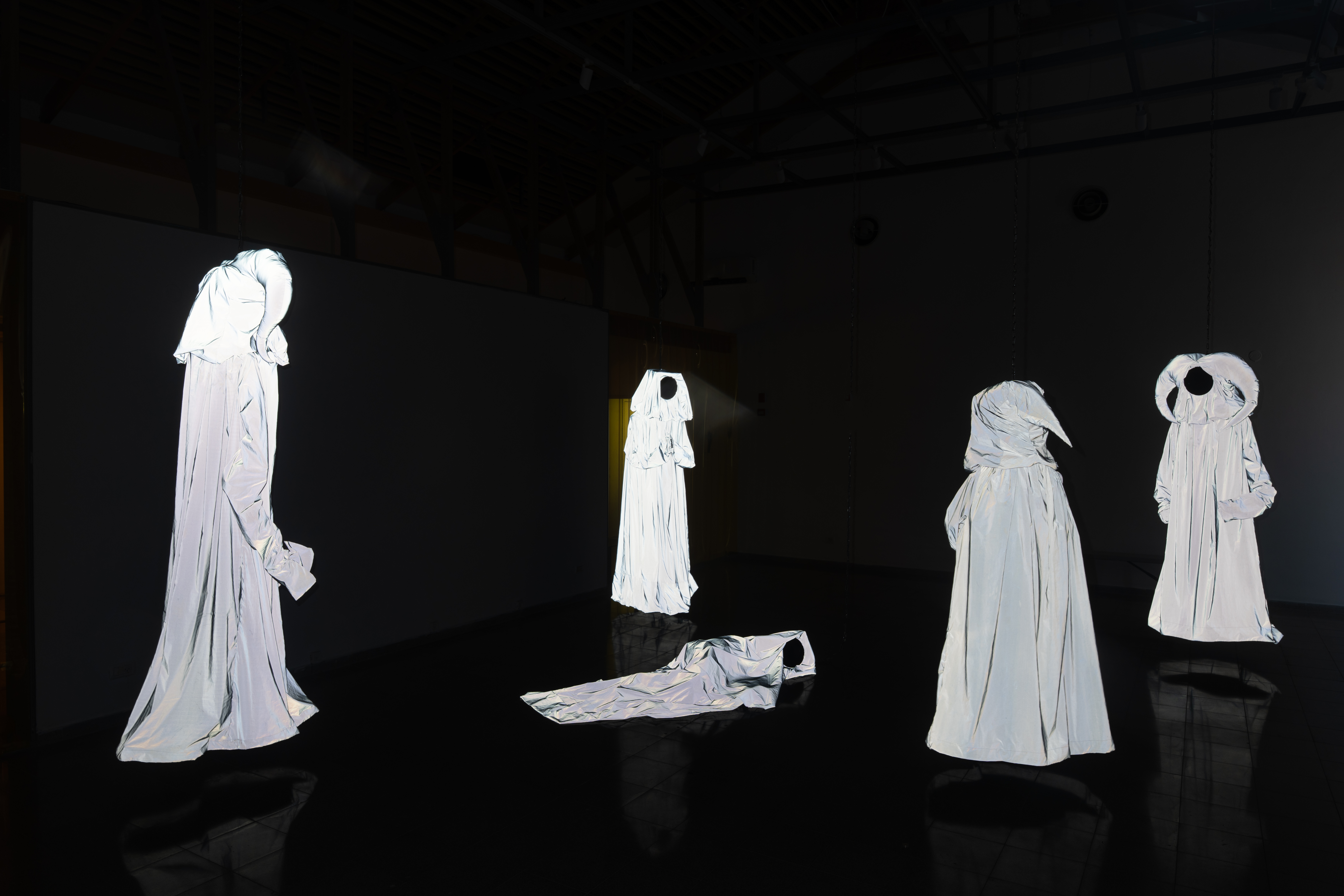
Digital print on a puffer jacket, metal clothes rack.
This item of clothing, identified with the security officer, is found in Israel at the entrance to every shopping mall, cinema, school or other large complex. In the work "Promise" it is placed in a slight and ironic disruption: instead of the word "Security" – in Hebrew: AVTAHA – that normally appears on it, the word "Promise" appears – in Herew: HAVTAHA.
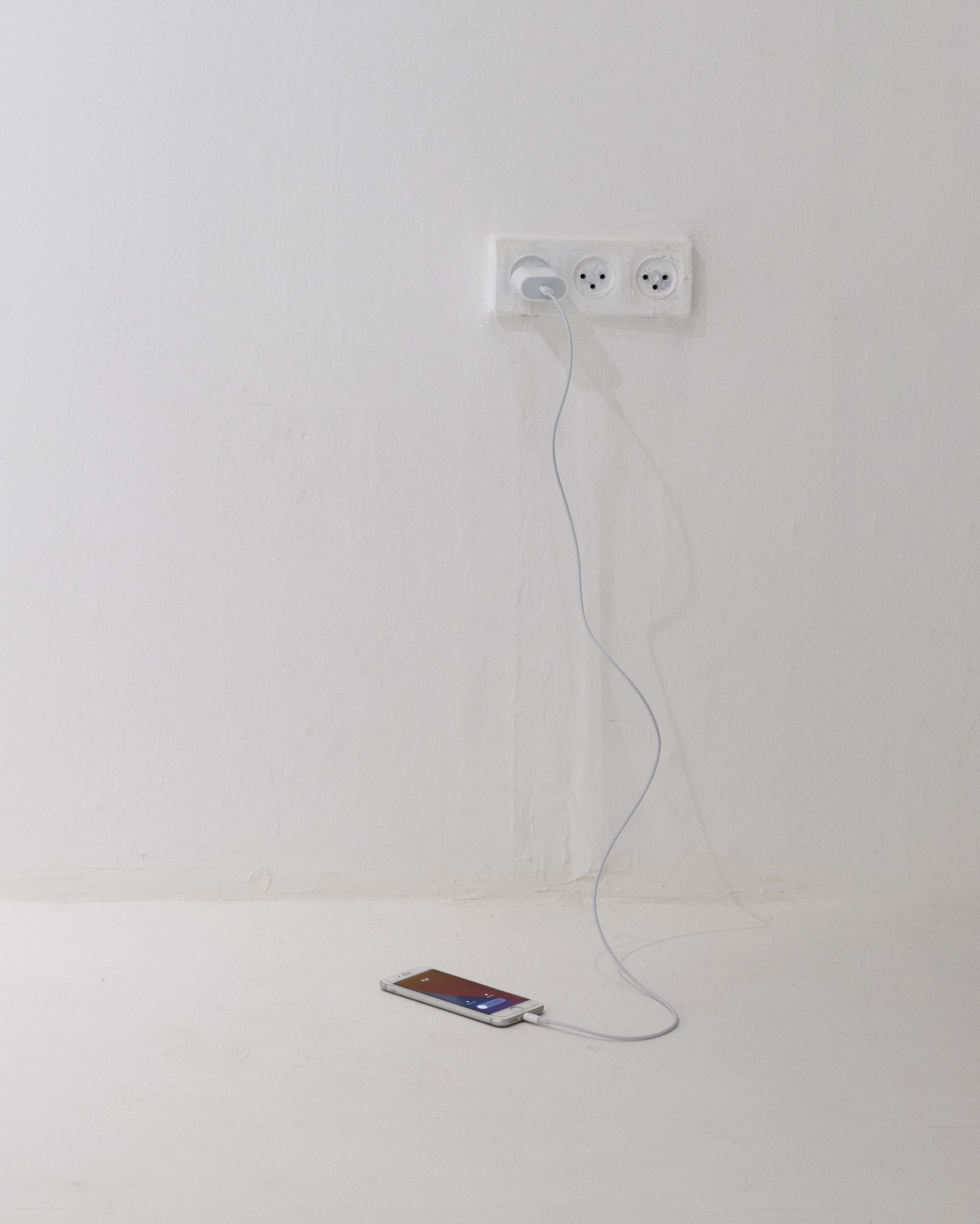
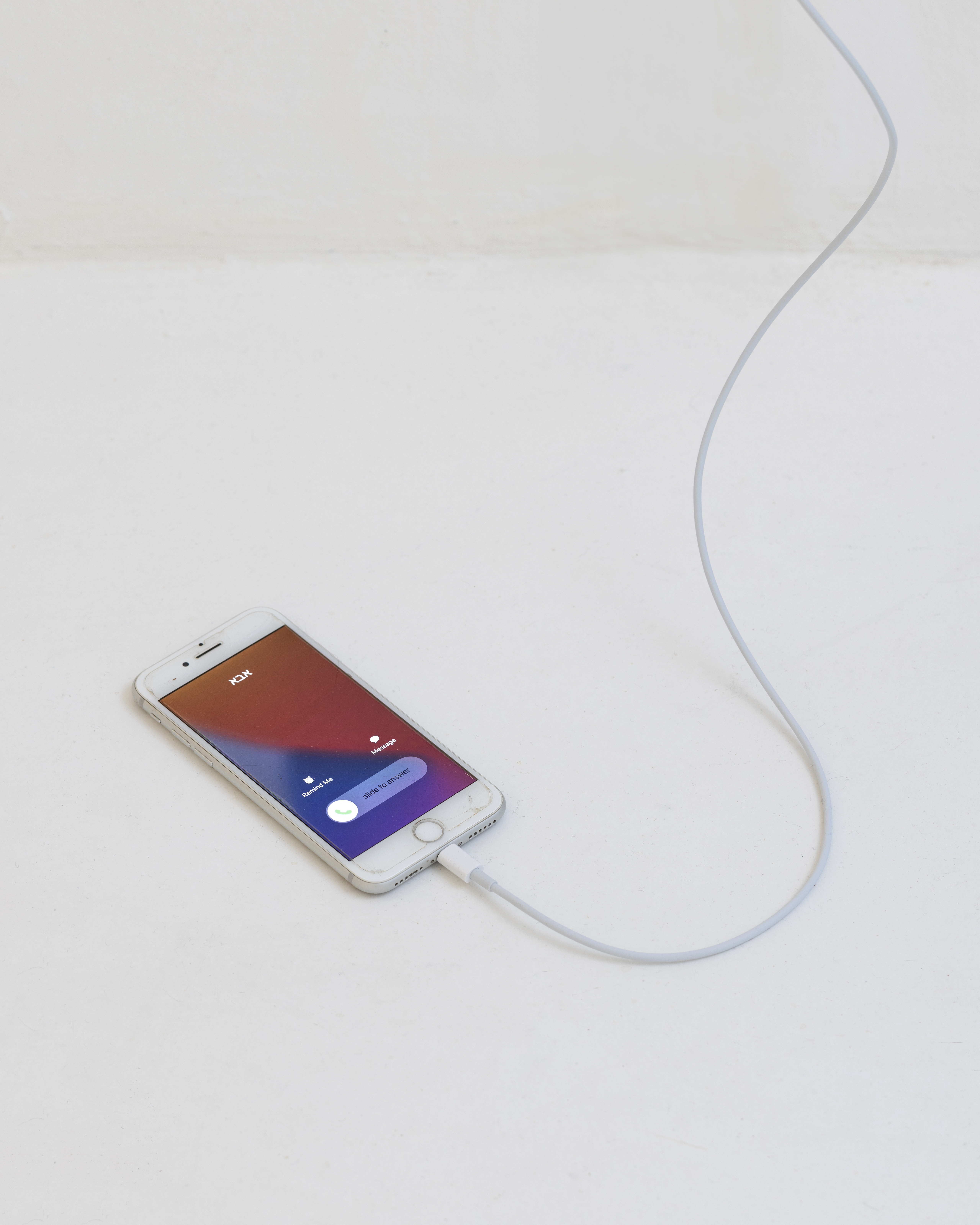
Video, mobile phone and charger, variable dimensions
A mobile phone is connected to a charger, that is connected to the wall. The word “Dad” appears on the screen. The phone rings non-stop, shining like a vertical light fixture on the floor of the space, stuck in a loop: an incoming, continuous, never-ending call.
Hopes Return
The World Is Big (2024)
The Lobby Art Space, Tel Aviv
Curator: Orit Mor
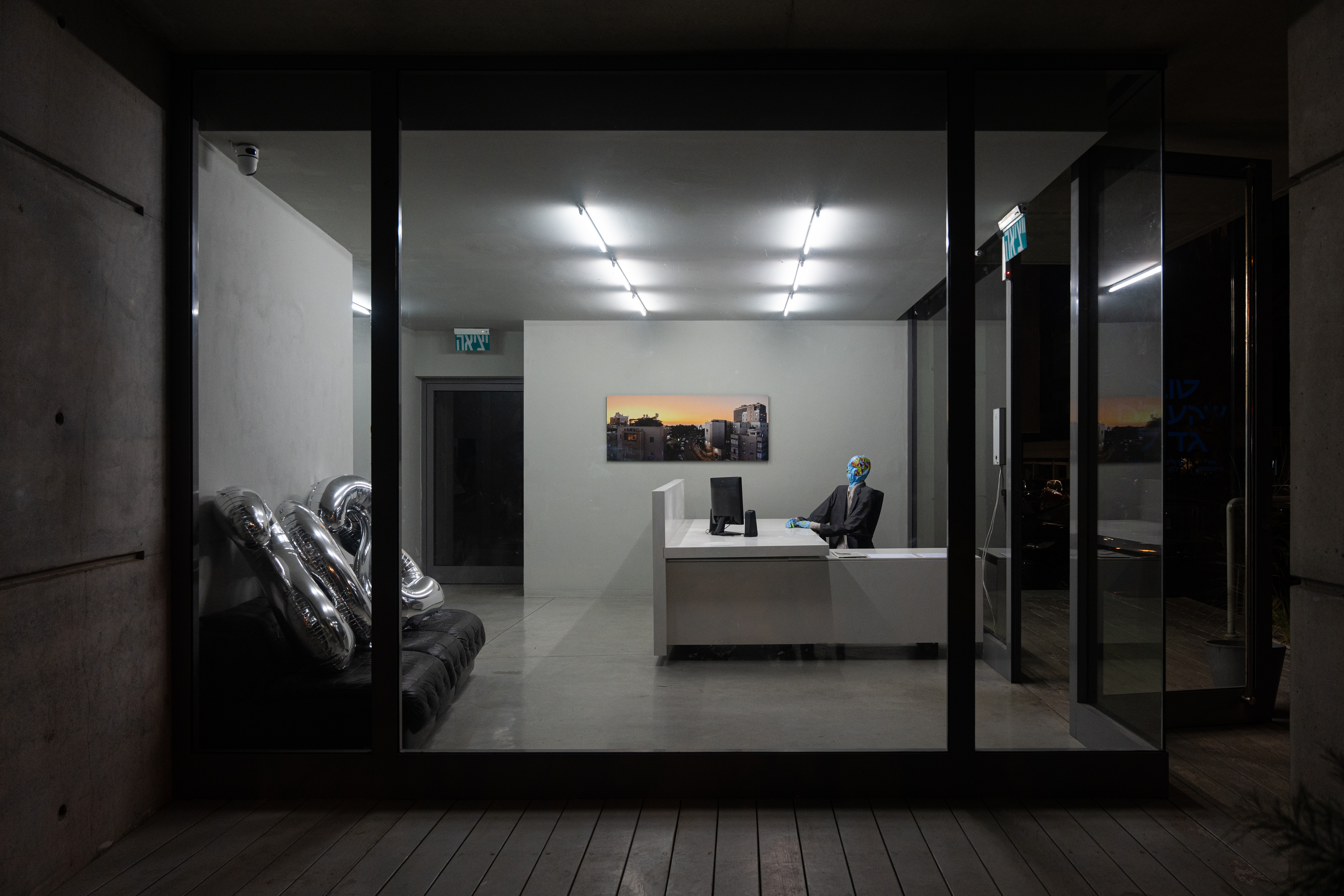
At the gallery's entrance, a massive reception desk greets visitors. Behind it is a slender, scarecrow-like figure named "Artzi." His head is an inflatable globe, and his body is clad in an old-fashioned suit. Artzi stares at an old computer screen, looping episodes of the Israeli ‘90s television show Masa Olami (World’s Journey), hosted by Eyal Peled. The program features Peled’s visits to famous cities around the globe, exploring their diverse tourist attractions.
To the right is a panoramic photograph of a Tel Aviv sunset, the kind you will typically find in waiting rooms. To the left is a retro waiting sofa, on which large silver balloons form the sequence “2025”. These balloons, which celebrate the arrival of the new year, are filled with air rather than helium, causing them to sag onto the sofa. A closer look reveals that the number 5 is an inverted 2, and the reflection of numbers on the building’s glass at night creates a mirror image that spells "SOS".
Installation views by Tomer Fruchter & Ben Alon
︎︎︎ Video documentation

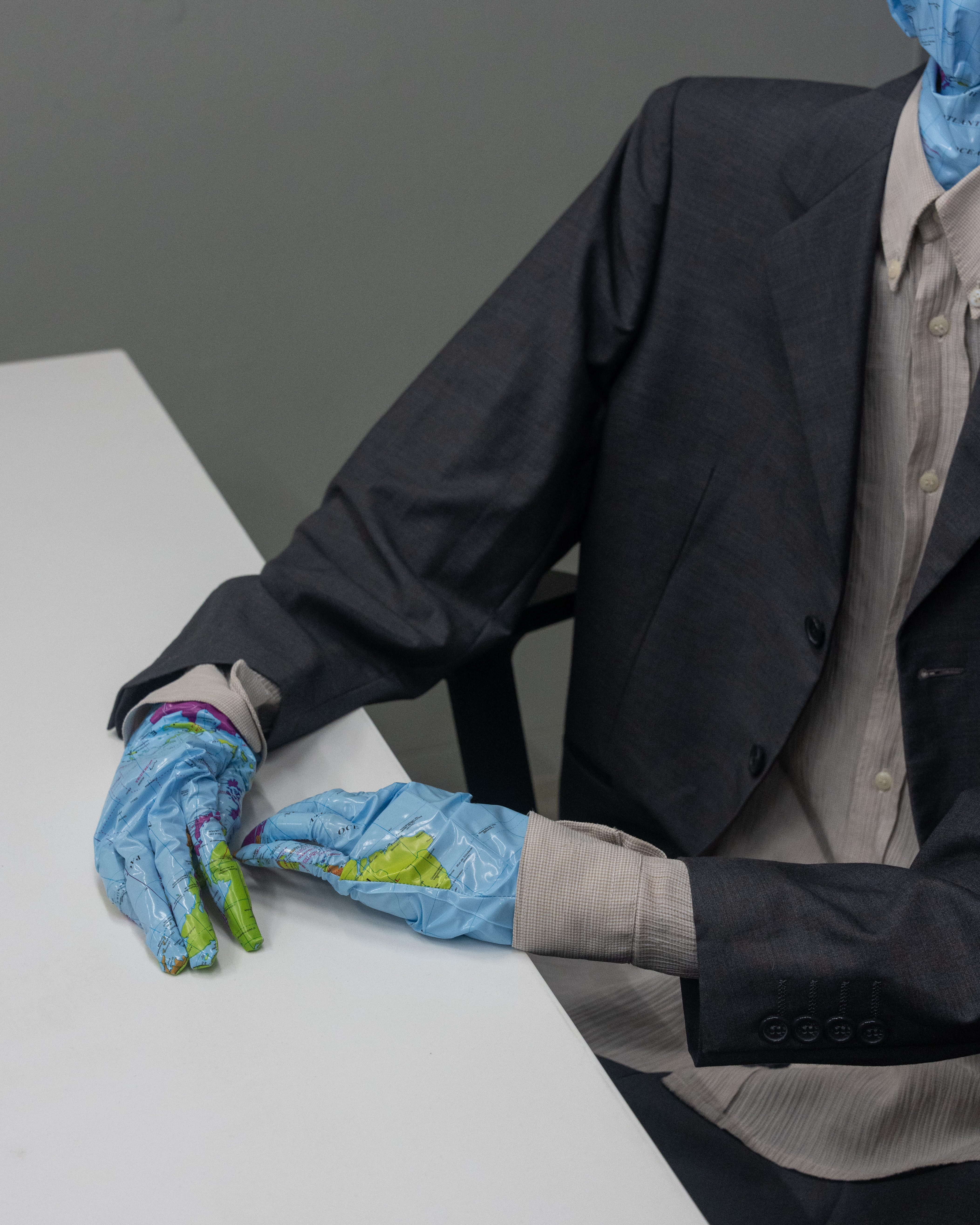

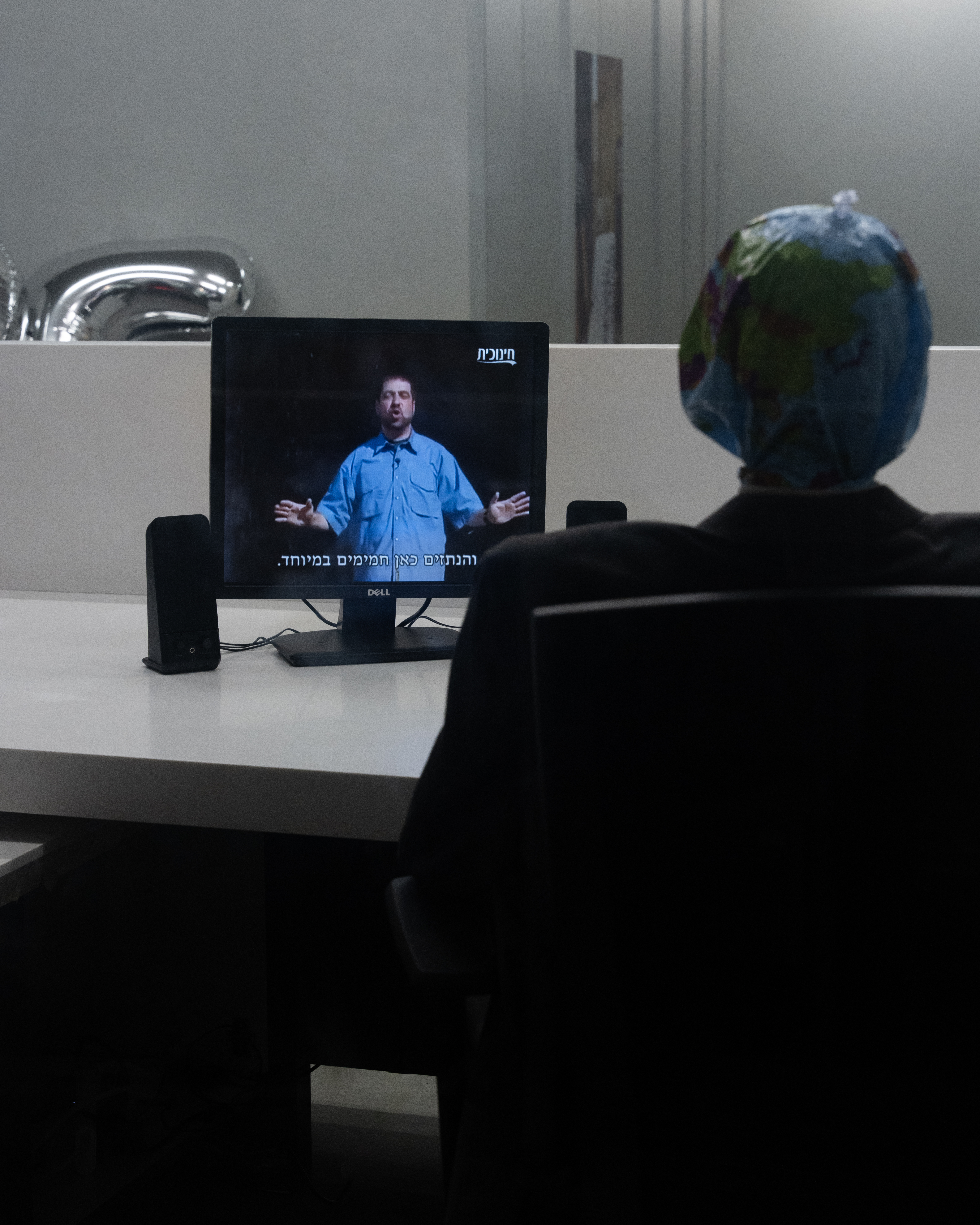
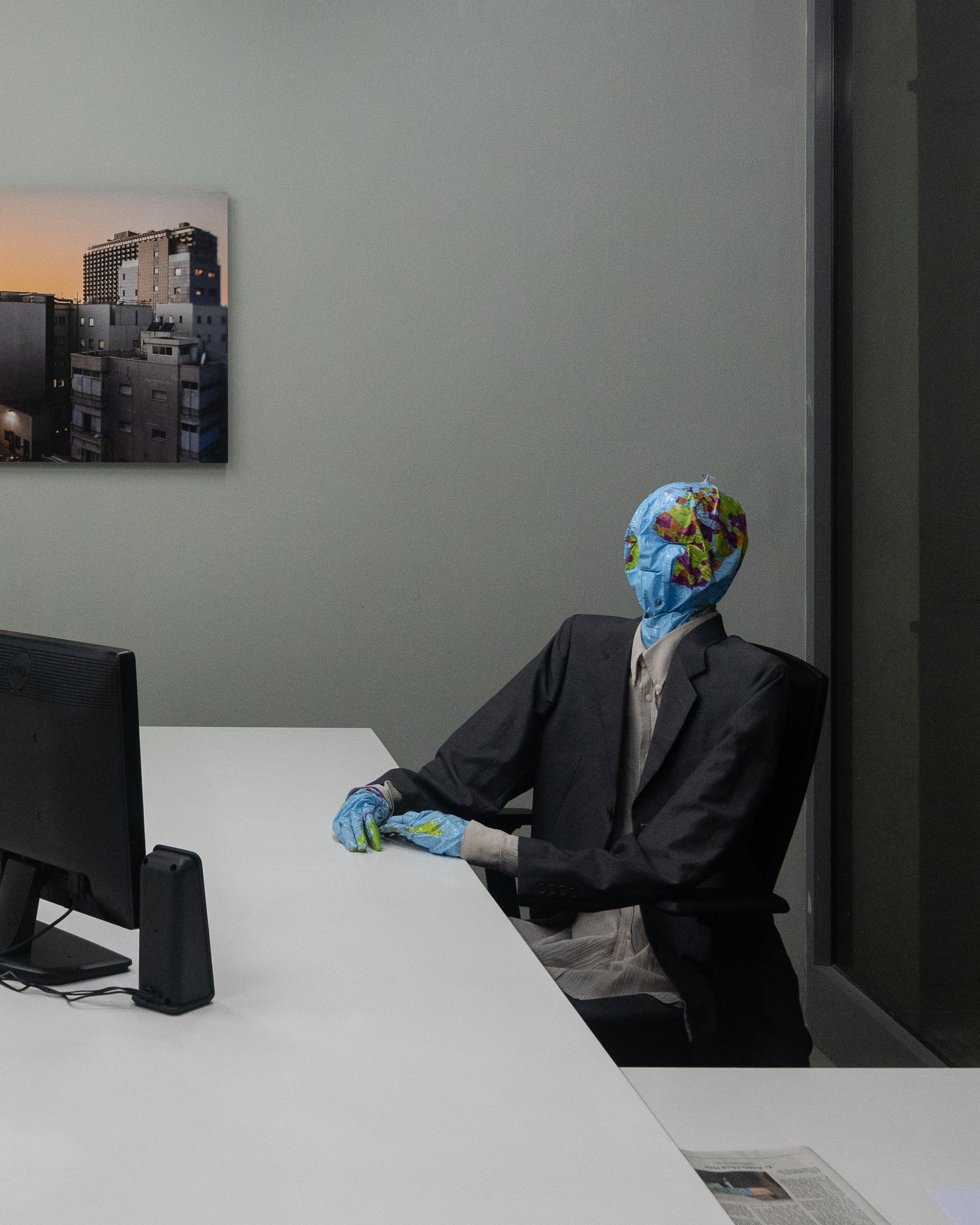
Artzi (2024)
mixed media

The View (2024)
Printed on Dibond, 150x60 cm

2025 (2024)
black leather couch, four silver balloons